
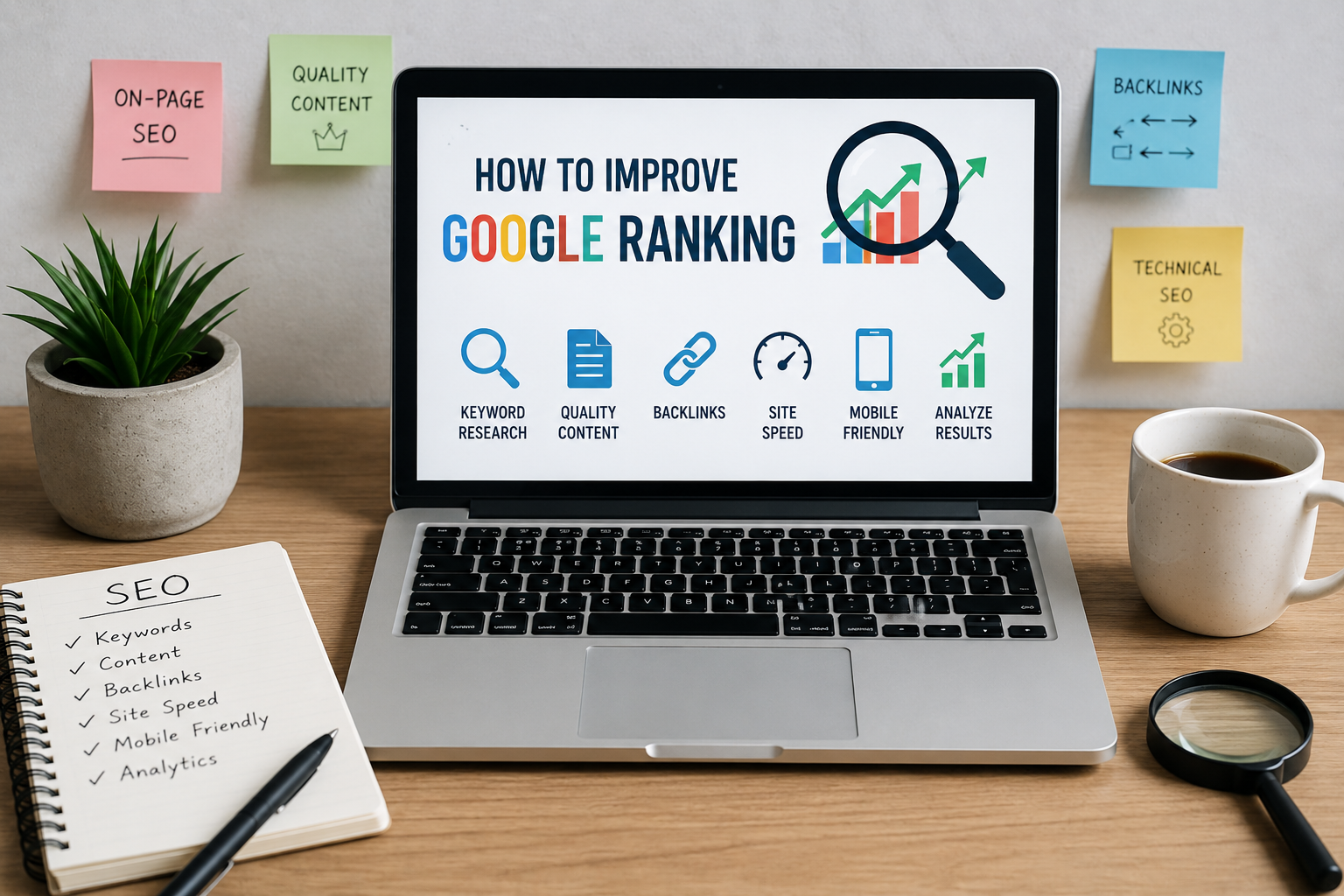
A Practical SEO Guide for Better Search Visibility
How to Improve Google Ranking:Getting your website to appear on the first page of Google can bring more visitors, leads, and potential customers to your business. However, Google rankings do not improve simply by adding more keywords to a page. Search engines consider many factors, including content quality, relevance, website experience, technical SEO, backlinks, and how well a page satisfies the user’s search intent.
If you are wondering how to improve Google ranking, this guide explains practical SEO strategies you can use to build better visibility and attract more organic traffic.
What Does Google Ranking Mean?
Google ranking refers to the position of a webpage in Google’s search results for a particular search query.
For example, if someone searches for “digital marketing services for small businesses”, the pages appearing near the top have stronger visibility for that particular query.
Higher rankings can potentially lead to:
- More organic website traffic
- Greater brand visibility
- More qualified visitors
- Increased leads and enquiries
- Better opportunities to generate sales
- Long-term organic growth
The goal should not simply be to rank for as many keywords as possible. Instead, your goal should be to create the most useful and relevant result for your target audience.
1. Understand Search Intent Before Creating Content
One of the most important steps in improving Google rankings is understanding search intent.
Search intent is the reason behind a user’s search.
For example:
- Informational: “How does SEO work?”
- Commercial: “Best SEO tools”
- Transactional: “Buy SEO software”
- Navigational: “Google Search Console”
If your target keyword is informational, creating a page that aggressively sells a service may not satisfy the user.
How to Match Search Intent
Before writing an article, search your target keyword on Google and examine the results.
Look at:
- What type of pages rank?
- Are they guides, product pages, videos, or comparison articles?
- What questions do they answer?
- How detailed are the top results?
- What information appears to be missing?
Then create content that addresses the searcher’s actual needs.
2. Perform Proper Keyword Research
Keyword research helps you understand what your audience searches for on Google.
Instead of targeting only broad keywords such as “SEO”, consider more specific phrases such as:
- How to improve Google ranking
- How to improve website SEO
- How to rank higher on Google
- SEO tips for small businesses
- How to get more organic traffic
- How to improve local Google ranking
Long-tail keywords can be particularly useful because they often reveal a specific problem or question.
Use Primary and Secondary Keywords
Choose one primary keyword for the page and naturally incorporate related topics and phrases.
For example:
Primary keyword:
Related keywords:
- improve website ranking
- Google SEO ranking
- rank higher on Google
- improve organic traffic
- SEO best practices
- website SEO tips
Avoid forcing keywords into every paragraph. Write naturally and focus on covering the topic comprehensively.
3. Create High-Quality, Helpful Content
Content quality is one of the most important parts of SEO.
A page should provide information that genuinely helps the reader accomplish something.
For example, an article about improving Google rankings should not simply define SEO. It should explain what the reader can actually do, why those actions matter, and how to implement them.
Make Your Content More Useful
Your content should:
- Answer the main question quickly
- Provide practical steps
- Include relevant examples
- Explain complicated concepts clearly
- Address common questions
- Avoid unnecessary repetition
- Use accurate and trustworthy information
- Be updated when information changes
A useful article is more likely to satisfy visitors than a page written primarily to manipulate search rankings.
4. Build a Strong Heading Structure
A clear heading structure makes your content easier for both users and search engines to understand.
Use:
H1: Main page title
H2: Major sections
H3: Supporting topics
H4: Detailed subtopics when necessary
For example:
H1: How to Improve Google Ranking
H2: Understand Search Intent
H3: Perform Keyword Research
H3: Improve On-Page SEO
H3: Optimize Title Tags
H3: Improve Meta Descriptions
H3: Use Descriptive URLs
H4: Improve Technical SEO
H4: Build Quality Backlinks
H4: Improve Website Experience
H4: Monitor Your SEO Performance
H3: Conclusion
A logical structure allows readers to scan the article and quickly find the information they need.
5. Optimize Your Title Tag
Your title tag helps Google and users understand what your webpage is about.
A good title should be:
- Relevant to the search query
- Clear and descriptive
- Specific
- Appealing to the target audience
- Naturally written
For this article, an example would be:
How to Improve Google Ranking: 10 Practical SEO Strategies
Instead of writing a generic title such as:
SEO Tips
make the topic and benefit clearer.
Your title should accurately represent what users will find on the page.
6. Write a Useful Meta Description
A meta description summarizes what a page is about and can influence whether someone chooses to click your result.
For example:
Learn how to improve Google ranking with practical SEO strategies covering keyword research, content, technical SEO, backlinks, user experience, and performance tracking.
A good meta description should accurately summarize the page rather than simply repeating keywords.
7. Improve Your Website’s Technical SEO
Technical SEO helps search engines discover, crawl, understand, and index your website.
Important areas include:
Mobile-Friendliness
Your website should work properly on smartphones and tablets.
Page Speed
Slow pages can create a poor user experience. Compress images, reduce unnecessary scripts, and use efficient website technology to improve loading performance.
HTTPS
Your website should use HTTPS to provide a secure connection.
Crawlability
Search engines need to be able to access important pages on your website.
Indexability
Make sure important pages are not accidentally blocked from being indexed.
XML Sitemap
An XML sitemap can help search engines discover important URLs on your site.
Fix Broken Links
Regularly check your website for broken internal and external links and fix them where appropriate.

8. Improve Your Core Web Vitals and Page Experience
Website experience matters because visitors expect pages to load and respond quickly.
Pay attention to Google’s Core Web Vitals, including:
- Largest Contentful Paint (LCP) – loading performance
- Interaction to Next Paint (INP) – responsiveness
- Cumulative Layout Shift (CLS) – visual stability
Improving these areas can make your website more pleasant to use.
However, SEO should not become a game of chasing individual technical scores. Focus on creating a website that is fast, stable, accessible, and easy to navigate.
9. Create Strong Internal Links
Internal linking means linking one page on your website to another relevant page.
For example, an article about improving Google rankings could link to related content about:
- Keyword research
- Technical SEO
- Local SEO
- Content marketing
- On-page SEO
- SEO analytics
Internal links can help users discover additional information and help search engines understand relationships between pages.
Best Practices for Internal Linking
Use descriptive anchor text.
Instead of:
Click here
use:
learn more about keyword research
The anchor text should naturally describe the destination page.
10. Earn High-Quality Backlinks
Backlinks are links from other websites to your website.
When reputable and relevant websites link to your content, those links can contribute to your site’s authority and visibility.
However, more backlinks does not automatically mean better rankings.
Focus on earning relevant, legitimate links through valuable content and genuine relationships.
Ways to Earn Backlinks
You can create:
- Original research
- Useful statistics
- Industry guides
- Case studies
- Expert resources
- Original data
- Helpful tools or calculators
- Comprehensive educational content
Avoid buying large numbers of low-quality links or participating in manipulative link schemes.
11. Update Existing Content
SEO is not always about publishing new articles.
Your existing content may already have impressions and rankings but could improve with updates.
Review older pages and look for:
- Outdated information
- Missing sections
- Broken links
- Weak explanations
- Old statistics
- Poor formatting
- New questions users are asking
For example, if an article ranks on page two of Google, improving its usefulness and relevance may be more productive than creating another article covering exactly the same topic.
12. Optimize Images for SEO
Images can improve the user experience, but they can also affect website performance.
Use:
- Relevant images
- Descriptive filenames
- Appropriate image formats
- Compressed file sizes
- Descriptive alt text where appropriate
For example, instead of:
IMG1234.jpg
use something descriptive such as:
digital-marketing-strategy.jpg
Do not stuff keywords into image alt text. Describe the image accurately.
13. Strengthen Your E-E-A-T Signals
Google’s quality guidance emphasizes Experience, Expertise, Authoritativeness, and Trustworthiness (E-E-A-T).
Year:ou can strengthen these signals by making it cl
- Who created the content
- What experience or expertise they have
- Where important information comes from
- How the information was researched
- How users can contact the organization
- Who operates the website
For topics where accuracy matters greatly, trustworthy sourcing and expert review become especially important.
14. Optimize for Local Search
If you operate a local business, improving your local search presence can help you reach customers searching in your area.
Create useful location-specific content such as:
- Digital marketing agency in Delhi
- SEO services for businesses in Haryana
- Local SEO guide for small businesses
- Digital marketing strategies for local businesses
Keep location pages genuinely useful and specific. Avoid creating dozens of nearly identical pages simply by replacing the city name.
15. Use Google Search Console to Monitor Performance
One of the best ways to understand your SEO performance is to use Google Search Console.
You can monitor:
- Search impressions
- Clicks
- Click-through rate
- Search queries
- Average position
- Indexed pages
- Technical issues
For example, if a page receives many impressions but few clicks, you could review its title and search-result presentation.
If a page ranks around positions 8–20, improving its content and internal linking may be worth investigating.
16. Track the Right SEO Metrics
Ranking position is useful, but it should not be your only measurement.
Track metrics such as:
Organic Traffic
How many visitors arrive through search engines?
Impressions
How often does your page appear in search results?
Click-Through Rate
How frequently do people click your result after seeing it?
Conversions
Are organic visitors completing meaningful actions such as enquiries, sign-ups, or purchases?
Engagement
Do visitors find your content useful enough to continue exploring your website?
Ultimately, business results matter more than rankings alone.
Common SEO Mistakes to Avoid
While working to improve Google rankings, avoid shortcuts that can damage your website’s long-term performance.
Keyword Stuffing
Repeating the same keyword excessively can make content difficult to read.
Duplicate Content
Publishing substantially similar pages without a useful reason can create SEO problems.
Buying Low-Quality Backlinks
Artificial link-building schemes can put your website at risk.
Writing Only for Search Engines
If your article sounds unnatural because it was written primarily for algorithms, users may leave quickly.
Ignoring Technical SEO
Excellent content can struggle if search engines cannot properly access or understand your website.
Publishing Without a Strategy
Creating hundreds of unrelated articles is generally less effective than building focused topical coverage.
How Long Does It Take to Improve Google Rankings?
There is no guaranteed timeline for SEO results.
Ranking improvements can depend on factors such as:
- Website age and authority
- Competition
- Content quality
- Technical health
- Search intent
- Backlink profile
- Industry
- Existing organic visibility
- Consistency of SEO work
Some pages may see improvements relatively quickly, while competitive keywords can take much longer.
SEO should therefore be treated as a long-term strategy rather than an instant traffic solution.
A Simple SEO Checklist
Before publishing a page, ask:
- Does the content satisfy the search intent?
- Is the primary topic clear?
- Is the H1 descriptive?
- Are H2 and H3 headings logically organized?
- Does the introduction answer the user’s question?
- Are keywords used naturally?
- Are relevant internal links included?
- Are images optimized?
- Is the page mobile-friendly?
- Does the page load efficiently?
- Are important technical SEO issues resolved?
- Is the information accurate and current?
- Does the content provide something genuinely useful?
- Is the author or business information clear?
Conclusion
Improving your Google ranking is not about finding one secret SEO trick. It is about consistently creating helpful, relevant, trustworthy content while maintaining a technically sound website.
Start by understanding search intent and researching the right keywords. Then improve your content structure, title, internal links, technical SEO, website experience, and authority. Use tools such as Google Search Console to measure performance and identify opportunities for improvement.
Most importantly, write for people first and optimize for search engines naturally. When your website consistently provides a better answer to what users are searching for, you create a stronger foundation for sustainable organic growth.
If your goal is to generate leads and customers, combine informational blog content like this with relevant service pages, strong internal linking, clear calls to action, and conversion-focused landing pages.