introduction
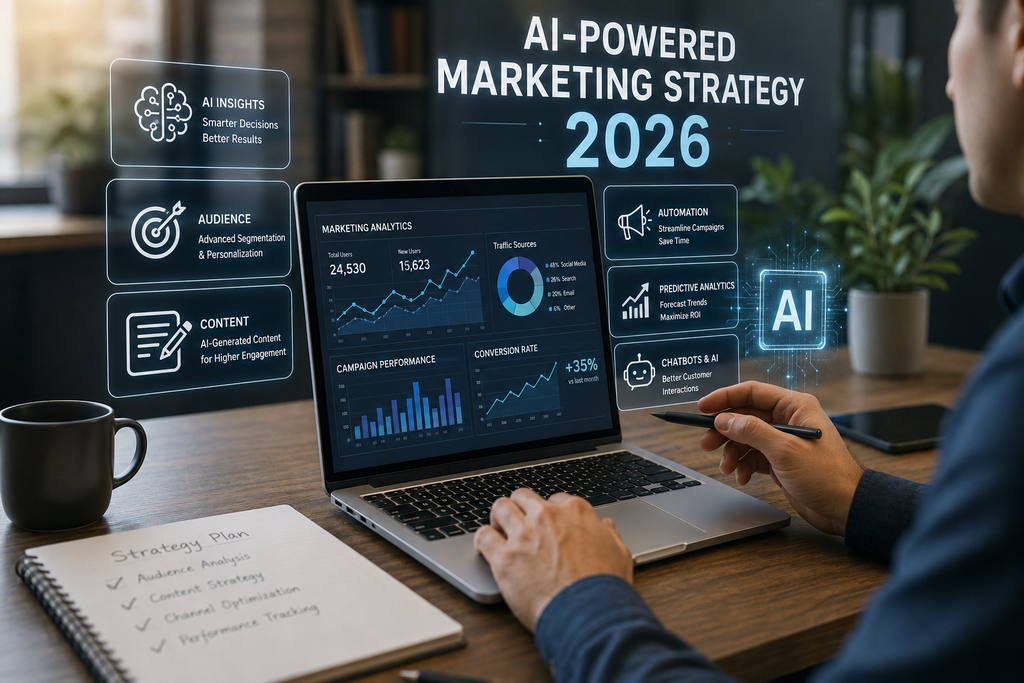
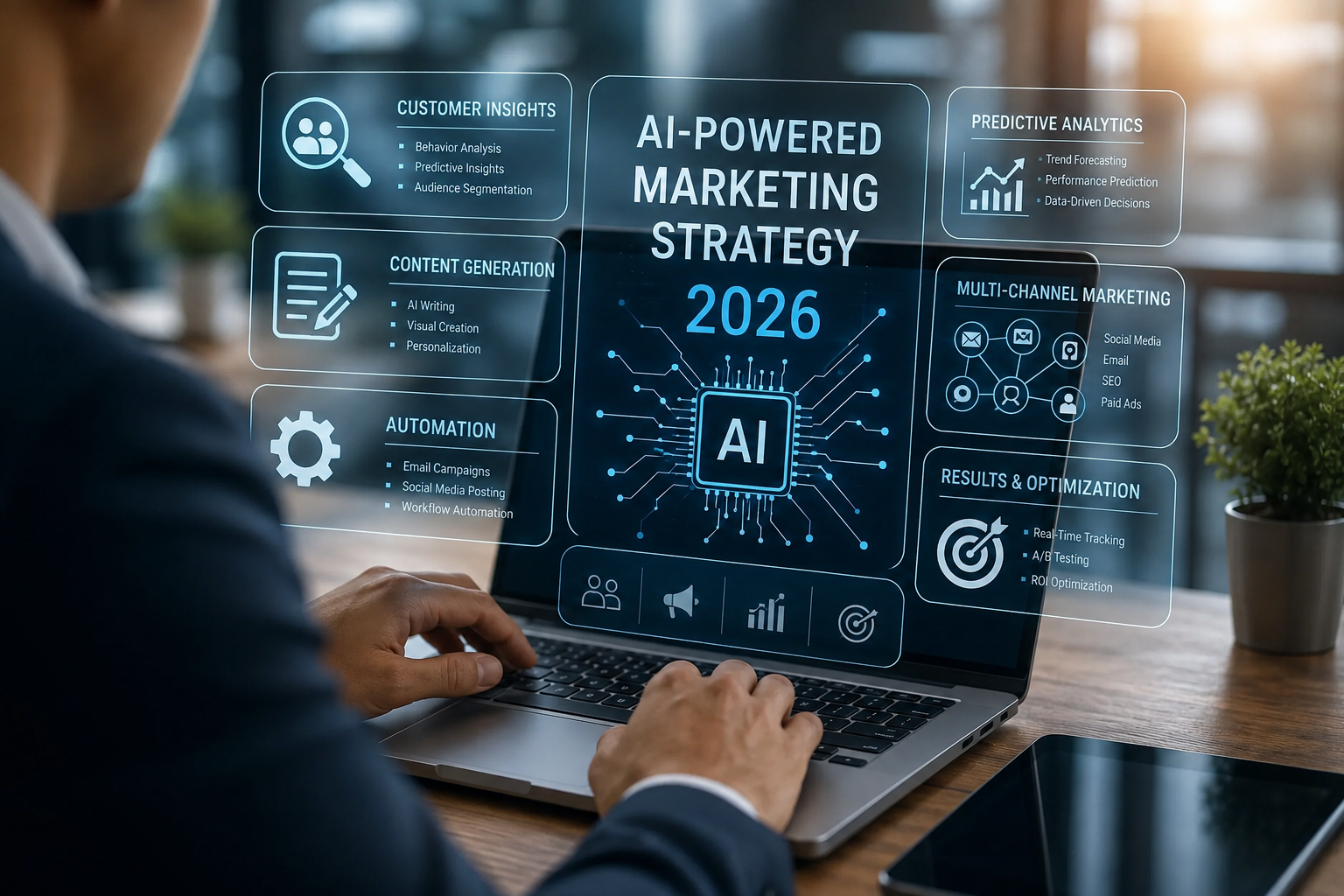
AI-Powered Marketing Strategy 2026 ?Marketing has been transformed by artificial intelligence (AI).Artificial Intelligence (AI) is revolutionizing marketing strategies, their execution, and measurement. AI can assist marketers in so many ways to work quicker SEO and make better decisions, from understanding customers’ behavior to creating content, analysing data, automating repetitive tasks, and improving advertising performance.
But, just using AI tools isn’t enough to create a successful marketing strategy. To implement this, businesses must have a clear workflow incorporating AI technology, business objectives, customer understanding, and ongoing optimization.
This guide explains how to develop a marketing strategy with AI, the tools and techniques available, and how to apply AI to various marketing channels, and how to measure their outcomes.
What is an AI-Powered Marketing Strategy 2026?
An AI fueled marketing strategy is a marketing plan that leverages AI and machine learning technologies to enhance marketing research, decision-making, customer personalization, content generation, marketing advertising, customer engagement and performance analysis.
Traditional marketing can be quite time-consuming and reliant on manual research. AI can process vast amounts of information to find patterns that might be hard for humans to find.
For instance, AI can assist a business:
- Define segments that could be potential customers.
- Understand how search and customer behaviour works.
- Generate content ideas
- Personalize marketing messages
- Optimize advertising campaigns
- Predict customer behavior
- Automate customer communication
- Analyze campaign performance
- Improve conversion rates
The objective is not to take the place of marketers. Rather, AI should enable marketers to allocate more time towards strategy, creativity, and customer relations.
1. Define Your Marketing Goals
Before selecting AI tools,SEO clearly define what you want your marketing strategy to achieve.
Your goals should be specific and measurable. For example, instead of saying, “We want more customers,” create a measurable goal such as:
“Generate 500 qualified leads within three months while maintaining a target cost per lead.”
Common marketing goals include:
- Increasing website traffic
- Generating leads
- Increasing online sales
- Improving brand awareness
- Increasing social media engagement
- Reducing customer acquisition costs
- Improving conversion rates
- Increasing customer retention
- Building email subscribers
AI can help optimize your campaigns, but it cannot determine your business priorities for you.
Start by defining the most important business outcome and then determine where AI can support it.
2. Know your target audience
One of the most crucial areas of marketing is audience research.
By analyzing customer data, website interactions, search trends, social media engagement, customer reviews, and purchasing behavior, AI can deliver valuable insights into the audience.
Create customer profiles based on factors such as:
- Age
- Location
- Profession
- Interests
- Buying behavior
- Problems
- Goals
- Budget
- Preferred communication channels
For instance, a digital marketing and SEO institute can target students in a college, job seekers, a business owner, a freelancer and a professional.
The needs of each audience are different.
A student might focus on career opportunities, whereas a business owner may be more concerned with generating leads and boosting sales.
AI tools can assist marketers in spotting these distinctions and developing more targeted campaigns.
3. Customer and Market research using AI.
Conducting market research manually can be very time consuming.
AI can streamline the research process for marketers, by structuring information, detecting patterns, summarising consumer feedback and creating research questions.
AI can be used to analyze:
- Customer reviews
- Competitor messaging
- Social media comments
- Survey responses
- Search trends
- Product feedback
- Frequently asked questions
If you are selling clothes online, and a lot of your customers are complaining about size, delivery and textiles, you can see the impact of these issues on your operations.If you have a clothing web-based organization and clients consistently bring up worries about size, conveyance, and fabric quality, you can picture the influence of such concerns on your business.
Those insights can impact on your marketing plan.
Instead of creating generic advertisements, you could create messaging such as:
“Simple size change, quick turnaround and top fabric.”
The secret to doing so is to identify insights through AI, but confirm key information with real customer and business dat
4. Develop an AI-Assisted Content Strategy
Content marketing is one of the areas where AI can save marketers significant time.
AI can help generate:
- Blog ideas
- Social media topics
- Video concepts
- Ad copy variations
- Email subject lines
- Product descriptions
- Content outlines
- FAQs
- Short-form video scripts
However, AI-generated content should not simply be published without review.
Human marketers should add:
- Original insights
- Real examples
- Brand experience
- Expert opinions
- Accurate information
- Unique perspectives
A strong workflow is:
Research → AI assistance → Human expertise → Editing → Fact-checking → Publishing → Performance analysis
This produces content that is faster to create while maintaining quality and authenticity.
5. Create an AI-Driven SEO strategy
Search engine optimization is also becoming increasingly influenced by AI.
AI can help with keyword research, understanding search intent, content planning, internal link opportunities, competitor research, and content optimization.
The first thing to do is to define the topics that your target customers are looking for.
Next, group keywords based on intent to search:
- Informational
- Commercial
- Transactional
- Navigational
In the case of someone looking for “what is SEO?,” they likely are wanting information.
If you get someone who types in “best SEO agency near me,” it might be with a commercial objective.
Anyone who types “buy SEO software” has transactional intent.
Business owners can tailor their content to align with the buyer’s path by understanding his intent.
While AI can contribute to organizing this information, it is essential for marketers to do some manual work to review search results and user intent.
6. Personalize Customer Experiences
Personalization can help to make marketing messages more relevant.
AI can interpret customer interactions and assist businesses in communicating with various segments of their audience in various ways.
For example:
If someone is visiting your site for the first time, they may receive an introductory offer.
A user who revisits the site can be recommended one of the products.
One returning customer may be offered a free new-product suggestion.
A customer who hasn’t made purchases in a while may be targeted in a re-engagement campaign.
Personalization can be achieved using AI across:
- Email marketing
- Website experiences
- Product recommendations
- Advertising
- Customer support
- Push notifications
- E-commerce campaigns
The goal is to get the marketing message to the customer to make them feel that it is relevant to their needs, not to others.
7. Use AI for Social Media Marketing
Managing multiple social media platforms can become time-consuming.
AI can assist with social media planning and content production by helping marketers generate content ideas, captions, scripts, hooks, and content calendars.
A useful AI-powered social media workflow can include:
Audience research → Content ideas → Script creation → Creative production → Scheduling → Performance analysis
AI can also help identify which content formats perform best.
For example, your data might show that:
- Educational reels generate high reach.
- Carousel posts generate saves.
- Testimonials generate leads.
- Promotional posts generate direct sales.
Instead of publishing content randomly, you can use these insights to build a data-driven content strategy.
8. Generate AI-Driven Product Ideas
The more relevant an email message is to the recipient, the more effective email marketing is.
By analyzing the behavior of the customers, AI can assist the marketers in designing email campaigns.
For example:
- Welcome email is an email that is sent when a new subscriber joins a list.
- Educational e-mail: Emailed to new prospects.
- Abandoned cart email: Sent when someone leaves products in their cart.
- Product recommendation email: Sending emails that recommend products based on what a user has bought.
- Re-engagement email: These are sent to customers who haven’t purchased from your brand for a while.
- AI can also provide variations to the subject line, customise content, and measure the level of engagement.
- But personalization should be meaningful and not just the use of a customer’s name in an email.
9. Automate repetitive marketing tasks.
Automation is one of the major advantages of AI.
Marketing teams dedicate a lot of time to repetitive tasks.
AI and automation can assist in:
- Lead qualification
- Email responses
- Customer support
- Social media scheduling
- Reporting
- Data organization
- Follow-up messages
- Content repurposing
An automated workflow, for instance, could:
- Capture the lead.
- Save to CRM.
- Categorize the lead.
- Personalize the e-mail.
- Inform sales department.
- Schedule a follow-up.
Marketers can concentrate on higher value activities with automation.
10. Incorporate AI Chatbots in Customer Interaction.
AI chatbots can answer frequently asked customer queries right away.
A chatbot may be able to respond to questions about:
- Pricing
- Services
- Products
- Availability
- Delivery
- Course information
- Appointment booking
- Frequently asked questions
Chatbots can be useful for businesses that get leads outside of their business hours.Chatbots can be very helpful for businesses that get leads outside of business hours.
But if the query is more complex or is sensitive, businesses must offer a means for customers to speak with a human representative.
11. Use Predictive Analytics
Historical data can be used to train AI systems to recognize patterns and predict future events.
Predictive marketing can enable companies to gain insight into:
- Who might be able to buy back again?
- Which leads have a higher chance of converting?
- What products could be in greater demand?
- Who might cease to interact with the customer?
- Which campaigns might be more successful?
To illustrate, an ecommerce business could study its buying history and discover customers that are prone to repeat.
The company can then devise campaigns specifically for these customers.
AI predictions are not certainty, so companies need to consider the AI prediction a business decision support tool, not a definitive answer.
12. Build a Strong Marketing Funnel
A marketing funnel is the journey a potential customer takes from first discovering your brand to becoming a paying customer and, eventually, a loyal customer. A strong marketing funnel helps businesses attract the right audience, build trust, generate leads, increase conversions, and improve customer retention.
A typical marketing funnel has five stages:
Awareness → Interest → Consideration → Conversion → Retention
13. Monitor the correct KPIs
Without results measured, AI is not a strategy.
KPIs should be clearly established that tie back to business goals.
Important metrics include:
- Website traffic
- Leads
- Conversion rate
- Cost per lead
- Customer acquisition cost
- Return on ad spend
- Revenue
- Customer lifetime value
- Email open rate
- Click-through rate
- Social engagement
- Retention rate
An ad can get thousands of clicks and few customers, for instance.
If that is the case, high traffic doesn’t necessarily equal good marketing.
Make sure marketing metrics are linked to business outcomes.
14. Monitor the appropriate KPI .
Lack of measurement of results is not a strategy.
To link marketing activities with business goals, businesses must identify KPIs.
Important metrics include:
- Website traffic
- Leads
- Conversion rate
- Cost per lead
- Customer acquisition cost
- Return on ad spend
- Revenue
- Customer lifetime value
- Email open rate
- Click-through rate
- Social engagement
- Retention rate
Thousands of clicks on an ad might lead to a few, or just a handful of, customers.
High traffic in such a case does not necessarily equal marketing success.
Always tie marketing metrics to business outcomes.
15. Maintain Human Oversight
While AI can deliver impressive results, it also has its limitations.
Information generated by AI can sometimes be incorrect, out-of-date, repetitive, or inappropriate for a target audience.
It is therefore vital to have human supervision.
Review: Before publishing AI-generated content or running an AI-assisted campaign, check:
- Accuracy
- Brand voice
- Facts
- Customer relevance
- Legal considerations
- Privacy
- Tone
- Originality
The best marketing strategy is one that’s fueled by AI efficiency and human insight.
16. Protect Customer Data
Protecting customer data is an essential part of an AI-powered marketing strategy. Businesses often collect information such as names, email addresses, phone numbers, purchase history, preferences, and website activity. This data must be handled responsibly and securely.
AI marketing tools should only receive the information they actually need. Businesses should avoid sharing sensitive customer information with unnecessary third-party tools and should carefully review the privacy and security practices of the platforms they use.
Important steps include:
- Collect only necessary customer data.
- Use secure systems to store information.
- Limit access to authorized employees.
- Follow applicable privacy and data-protection laws.
- Clearly explain how customer data is collected and used.
- Regularly review connected AI and marketing tools.
- Delete information that is no longer required.
- Monitor systems for unusual activity or potential security issues.
17 Test, Analyze and Optimize.
The first AI-driven campaign doesn’t have to be the best.
Continuous testing is vital to successful marketing.
Test different:
- Audiences
- Headlines
- Offers
- Creatives
- Landing pages
- Calls to action
- Email messages
- Content formats
Apply performance data to find out what is successful.
For example:
Create → Launch → Measure → Learn → Improve → Relaunch
This process creates a continuous improvement cycle.
AI can make the analysis process faster, but marketers still need to decide which changes make strategic sense.
Common Mistakes to Avoid
Businesses often make mistakes when adopting AI for marketing.
1. Using Too Many AI Tools
You do not need dozens of AI platforms.
Choose tools based on your actual business needs.
2. Publishing Generic AI Content
AI-generated content without original value can become repetitive.
Add experience, examples, research, and human expertise.
3. Ignoring Customer Data
AI works best when it has useful information to analyze.
Use reliable customer and campaign data whenever possible.
4. Focusing Only on Automation
Automation is useful, but marketing is also about relationships and creativity.
Do not automate every customer interaction.
5. Measuring Vanity Metrics
Likes and impressions can be useful, but they should not be the only performance indicators.
Focus on metrics connected to business outcomes.
A Simple AI-Powered Marketing Framework
You can create your strategy using this seven-step framework:
1. Define: Set clear business and marketing goals.
2. Research: Analyze customers, competitors, markets, and search behavior.
3. Plan: Build your content, advertising, SEO, social media, and email strategy.
4. Create: Use AI to accelerate content and creative production.
5. Personalize: Deliver relevant experiences to different customer segments.
6. Automate: Automate repetitive workflows and follow-ups.
7. Optimize: Analyze performance and continuously improve.
This framework can work for startups, small businesses, agencies, e-commerce brands, and larger organizations.
Final Thoughts
An AI marketing strategy is not just about leveraging ChatGPT or any other AI tool for content creation. It’s about creating a smarter marketing system with AI assisting in research, personalization, automation, content generation, advertising, analytics, and decision-making.
Not every company that leverages AI tools will be successful. They’re the companies that will understand how to tap into the value and capabilities of AI, and to integrate it with sound marketing principles.
Begin with a single business goal. State the issue or problem you are trying to solve in marketing. Select the right AI technology, pilot the technology at a small scale, evaluate outcomes and refine.
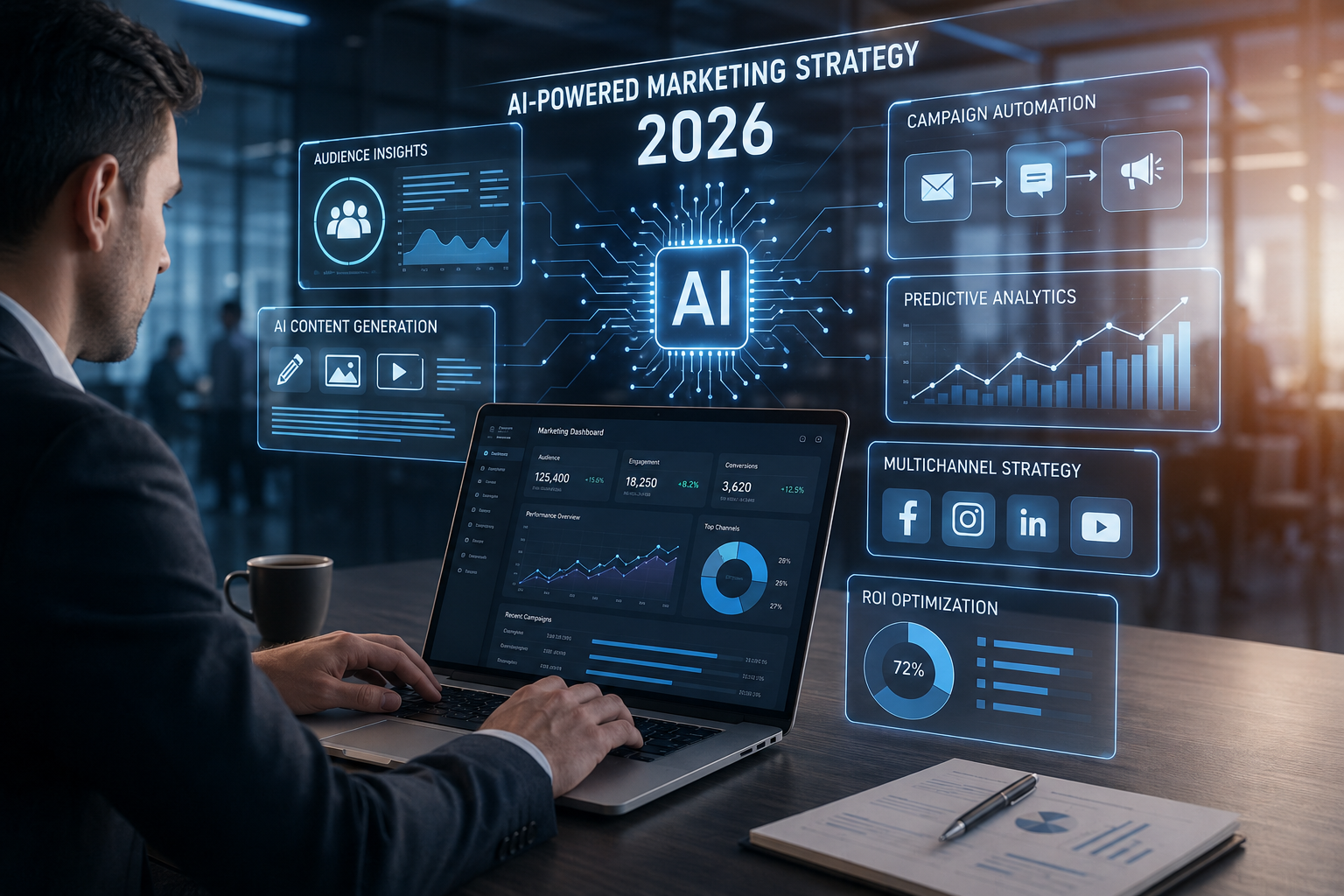
AI can be a significant competitive edge in today’s digital marketing landscape when it is backed by customer knowledge, creative thinking, strategic planning, high-quality data, and human supervision.
The future of marketing is not about AI taking the place of marketers. It’s marketers who are getting faster, smarter and more effective with AI.