
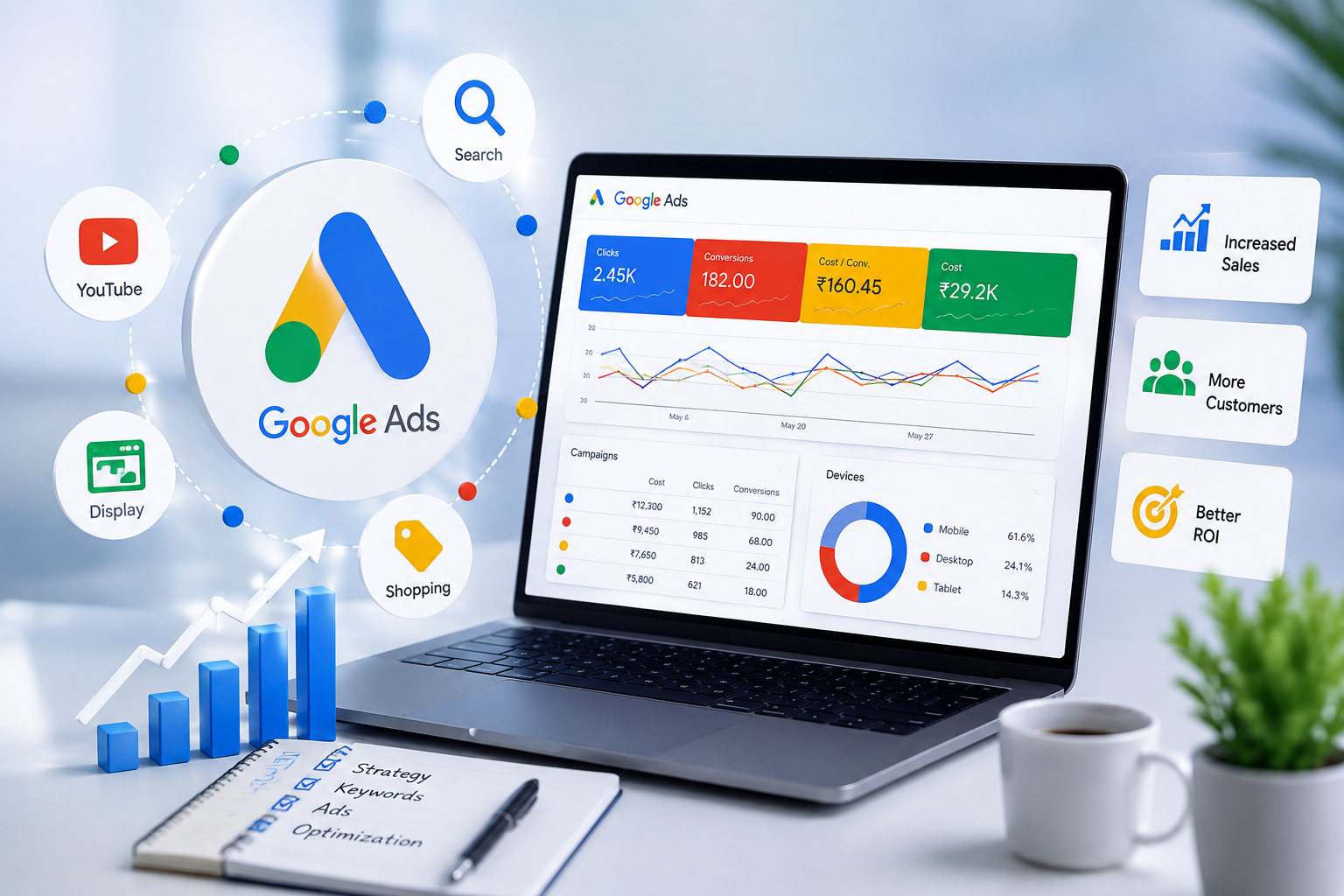
A Complete Guide to Growing Your Business with Paid Search
Google Ads has become one of the most effective ways for businesses to reach potential customers at the exact moment they are searching for products or services. However, simply creating a Google Ads campaign does not guarantee leads, sales, or a strong return on investment. Successful paid advertising requires proper keyword research, campaign planning, compelling ad copy, conversion tracking, budget management, and continuous optimization.
This is where Google Ads management services can make a significant difference. Professional management helps businesses build targeted campaigns, control advertising costs, improve ad performance, and generate qualified leads.
Whether you run a local business, e-commerce store, startup, professional service company, or growing enterprise, effective Google Ads management can help you compete for valuable search traffic and turn clicks into customers.
What Are Google Ads Management Services?
Google Ads management services involve planning, creating, monitoring, optimizing, and improving paid advertising campaigns on Google’s advertising platforms.
A professional Google Ads management company or specialist typically handles:
- Keyword research and selection
- Campaign and ad group creation
- Search, Display, Shopping, and other campaign types
- Ad copywriting
- Audience targeting
- Conversion tracking
- Bid and budget management
- Negative keyword management
- Landing page recommendations
- Performance monitoring
- A/B testing
- Campaign optimization
- Reporting and performance analysis
The primary goal is not simply to increase clicks. The goal is to attract the right users, generate qualified traffic, increase conversions, and improve return on advertising spend.
Why Do Businesses Need Google Ads Management?
Google Ads can deliver fast visibility, but managing campaigns effectively requires experience and ongoing attention.
A poorly managed campaign can waste money through irrelevant keywords, low-quality traffic, weak advertisements, incorrect targeting, or inefficient bidding strategies.
Professional Google Ads management helps businesses address these challenges by using data to make informed decisions.
1. Reach Customers With High Purchase Intent
One of the biggest advantages of Google Ads is intent-based targeting.
For example, someone searching for “Google Ads management services for small business” is likely to have a stronger commercial intent than someone searching for a general term such as “online advertising.”
By targeting relevant high-intent keywords, businesses can reach users who are actively researching, comparing, or preparing to purchase.
2. Generate Leads Faster
SEO can be an excellent long-term marketing strategy, but it can take time to build organic visibility. Google Ads can place a business in front of relevant searchers much faster.
When campaigns are properly structured and optimized, paid search can become a reliable source of:
- Phone calls
- Form submissions
- Consultation requests
- Product purchases
- Bookings
- Website inquiries
3. Control Your Advertising Budget
Google Ads allows businesses to establish daily and campaign-level budgets.
Professional management focuses on allocating budget toward campaigns, keywords, locations, devices, and audiences that generate better results.
This can help reduce unnecessary spending while increasing investment in profitable opportunities.
How Google Ads Management Services Work
Effective campaign management follows a structured process. Every business has different goals, customers, competitors, and budgets, so campaigns should be customized accordingly.
Step 1: Understand Business Goals
The first step is identifying what the business wants to achieve.
Common objectives include:
- Increasing online sales
- Generating qualified leads
- Increasing phone calls
- Promoting local services
- Increasing website traffic
- Building brand awareness
- Promoting specific products
- Improving customer acquisition
Clear objectives make it easier to choose the right campaign type and measure success.
Step 2: Conduct High-Intent Keyword Research
Keyword research is one of the most important parts of paid search management.
A professional strategy focuses on keywords that are closely connected to the products or services being offered.
For example, a digital marketing company may target keywords such as:
- Google Ads management services
- Google Ads agency
- PPC management services
- Google Ads services for small business
- professional Google Ads management
- affordable Google Ads management
- Google Ads campaign management
Keyword selection should consider search intent, competition, estimated cost, relevance, and potential conversion value.
Step 3: Organize Campaigns and Ad Groups
Campaign structure influences how efficiently an account can be managed.
Instead of placing unrelated keywords into one large campaign, advertisers can organize keywords around specific products, services, locations, or customer needs.
A well-organized structure makes it easier to create relevant advertisements and analyze performance.
Step 4: Create Compelling Ad Copy
Your advertisement is often the first interaction a potential customer has with your business.
Effective Google Ads copy should communicate:
- The primary service or product
- A clear benefit
- A relevant value proposition
- A strong call to action
- Trust-building information when appropriate
Examples of calls to action include:
- Get a Free Consultation
- Request a Quote
- Contact Our Team
- Book a Consultation
- Shop Now
- Get Started Today
Ad copy should match the searcher’s intent instead of using generic marketing language.
Types of Google Ads Campaigns
Google offers multiple advertising formats, allowing businesses to reach customers across different stages of the buying journey.
Search Ads
Search campaigns appear when users search for relevant keywords on Google.
They are particularly valuable for businesses targeting high-intent searches such as service-related or product-related queries.
Display Ads
Display advertising can help businesses reach audiences across websites and apps within Google’s advertising network.
Display campaigns can support awareness, remarketing, and broader customer acquisition strategies.
Shopping Ads
For e-commerce businesses, Shopping campaigns can showcase products directly in search results.
Product images, prices, and other information can help users compare options before visiting a website.
Video Advertising
Video campaigns can help businesses promote products, services, and brands through video placements.
They can be useful for increasing awareness, demonstrating products, and reaching specific audiences.
Performance Max Campaigns
Performance Max campaigns allow advertisers to access multiple Google inventory channels through a unified campaign approach.
They can be useful when businesses have clear conversion goals and sufficient data for optimization.
The Importance of Conversion Tracking
Getting clicks is not the same as getting customers.
This is why conversion tracking is essential for Google Ads management.
Businesses should identify meaningful actions, such as:
- Completed purchases
- Lead forms
- Phone calls
- Appointment bookings
- Quote requests
- Newsletter sign-ups
- Important website interactions
Accurate conversion tracking helps advertisers understand which campaigns and keywords are producing valuable results.

Without reliable tracking, it becomes difficult to determine whether advertising money is generating business outcomes.
Google Ads Optimization: Why It Matters
Launching a campaign is only the beginning.
Successful Google Ads campaigns require continuous monitoring and optimization.
Negative Keyword Management
Negative keywords prevent advertisements from appearing for irrelevant searches.
For example, if a company sells premium professional services, it may want to exclude searches related to free tools, jobs, courses, or unrelated informational queries.
Regular negative keyword research can reduce wasted clicks and improve traffic quality.
Bid Optimization
Bidding strategies determine how advertising budgets are used.
Depending on campaign objectives and available data, advertisers may use strategies focused on clicks, conversions, conversion value, or other goals.
The appropriate strategy depends on the account’s objectives and performance history.
A/B Testing
Testing different advertisements can reveal which messaging produces better results.
Advertisers can test variations of:
- Headlines
- Descriptions
- Calls to action
- Offers
- Value propositions
- Landing pages
Testing should be based on meaningful data rather than assumptions.
Google Ads and Landing Page Optimization
Even an excellent advertisement cannot compensate for a poor landing page.
When users click an ad, the landing page should provide a clear and relevant experience.
An effective landing page should generally have:
- A clear headline
- Relevant information
- Strong benefits
- Easy navigation
- Mobile-friendly design
- Trust signals
- A noticeable call to action
- Fast loading performance
The message on the landing page should closely match the promise made in the advertisement.
For example, if an ad promotes “Google Ads management for small businesses,” the landing page should immediately explain that specific service instead of sending users to an unrelated homepage.
How to Measure Google Ads Performance
Professional Google Ads management should be based on measurable results.
Important metrics include:
Click-Through Rate (CTR)
CTR indicates how frequently users click an advertisement after seeing it.
A higher CTR can indicate that the ad is relevant to the audience and search query.
Cost Per Click (CPC)
CPC represents the average amount paid for a click.
Monitoring CPC helps businesses understand how efficiently their advertising budget is being used.
Conversion Rate
Conversion rate measures the percentage of users who complete a desired action after clicking an advertisement.
Cost Per Acquisition (CPA)
CPA helps businesses understand how much advertising spend is required to generate a conversion.
Return on Ad Spend (ROAS)
For businesses focused on revenue, ROAS can help measure the revenue generated in relation to advertising expenditure.
The most important metric depends on the business model and campaign objective.
Benefits of Hiring a Google Ads Management Company
Managing Google Ads internally can be challenging, particularly when a business has limited time or experience.
Hiring professional Google Ads management services can provide several advantages.
Save Time
Campaign management involves research, monitoring, testing, reporting, and optimization. Outsourcing these activities allows business owners to focus on their core operations.
Reduce Wasted Advertising Spend
Professional management can identify irrelevant search terms, weak-performing campaigns, ineffective advertisements, and inefficient budget allocation.
Access Specialized Expertise
Google Ads specialists understand campaign structures, keyword targeting, bidding strategies, conversion tracking, and optimization techniques.
Improve Campaign Performance
Continuous optimization can help businesses identify opportunities to improve traffic quality, conversions, and overall advertising efficiency.
Receive Performance Insights
Regular reports can show businesses where their advertising budget is going and what results it is generating.
How to Choose the Best Google Ads Management Services
Choosing the right provider is an important business decision.
Before hiring an agency or specialist, consider the following factors.
Experience
Look for experience managing campaigns similar to your industry, business model, and target audience.
Transparent Reporting
A reliable provider should explain campaign performance clearly and provide understandable reports.
Clear Pricing
Ask how management fees are structured and what services are included.
Conversion-Focused Strategy
Avoid providers that focus only on impressions and clicks. Your strategy should ultimately support meaningful business objectives.
Communication
Good communication ensures that campaign decisions remain aligned with business goals.
Google Ads Management Costs
The cost of Google Ads management varies depending on several factors, including:
- Monthly advertising budget
- Number of campaigns
- Industry competition
- Geographic targeting
- Number of products or services
- Campaign complexity
- Management scope
- Conversion goals
Businesses should distinguish between Google Ads spend and management fees.
The advertising budget is paid to run the campaigns, while management fees compensate the agency or specialist for campaign strategy, setup, monitoring, optimization, and reporting.
Rather than choosing a provider based solely on the lowest price, businesses should evaluate potential return, expertise, transparency, and service quality.
Common Google Ads Mistakes to Avoid
Several mistakes can reduce campaign performance.
Targeting Too Many Broad Keywords
Broad targeting can generate irrelevant traffic if it is not carefully controlled.
Ignoring Search Terms
Search-term analysis can reveal irrelevant queries and new keyword opportunities.
Sending Every Visitor to the Homepage
A dedicated landing page is often more relevant to specific campaigns.
Failing to Track Conversions
Without conversion tracking, it is difficult to measure real campaign success.
Setting and Forgetting Campaigns
Google Ads performance can change over time because of competition, search behavior, seasonality, and market conditions.
Focusing Only on Clicks
A large number of clicks does not automatically mean a successful campaign. Businesses should focus on qualified traffic and meaningful conversions.
Google Ads Management for Small Businesses
Small businesses often need to make every advertising dollar count.
A focused Google Ads strategy can help local and small businesses reach customers searching for specific products and services.
For example, a local service company can target relevant searches within selected geographic areas instead of advertising to an entire country.
Location targeting, call-focused campaigns, relevant keywords, strong offers, and optimized landing pages can help small businesses attract more qualified prospects.
Google Ads Management for E-Commerce Businesses
E-commerce businesses can use Google Ads to promote individual products and reach shoppers who are actively comparing purchasing options.
Successful e-commerce advertising often requires attention to:
- Product feeds
- Product titles
- Product descriptions
- Pricing
- Shopping campaigns
- Conversion tracking
- Remarketing
- Product-level performance
- Return on ad spend
The objective is to identify products and audiences that generate profitable sales and allocate advertising budgets accordingly.
Google Ads vs. SEO: Which Is Better?
Google Ads and SEO serve different purposes.
Google Ads can provide immediate paid visibility and allow advertisers to target specific searches, audiences, locations, and customer segments.
SEO focuses on improving organic search visibility and building sustainable search traffic over time.
For many businesses, the strongest strategy is not choosing one over the other. Instead, combining paid search with SEO can create a more comprehensive search marketing strategy.
Google Ads can provide immediate data about keywords, customer behavior, and conversion opportunities, while SEO can support long-term organic growth.
Why Continuous Google Ads Management Is Important
Digital advertising is constantly changing.
Competitors can adjust their bids, search behavior can change, costs can fluctuate, and new keywords can emerge.
That is why effective Google Ads management should be an ongoing process.
A strong management cycle includes:
Research → Launch → Measure → Analyze → Optimize → Test → Repeat
This continuous approach helps businesses make decisions based on actual campaign data instead of assumptions.
Conclusion
Google Ads management services can help businesses turn paid search advertising into a more structured and measurable customer acquisition channel. From keyword research and campaign creation to conversion tracking, bid management, negative keywords, landing page optimization, and performance analysis, every element contributes to campaign success.
The key is to remember that successful Google Ads advertising is not simply about getting more clicks. It is about reaching the right audience, delivering relevant advertisements, creating a strong user experience, and generating valuable conversions while managing advertising costs effectively.
Whether you are a small business looking for local leads, an e-commerce company seeking more online sales, or a growing organization trying to increase qualified inquiries, professional Google Ads management can provide the strategy and ongoing optimization needed to compete effectively.
By combining high-intent keyword targeting, compelling ad copy, accurate conversion tracking, smart budget management, and continuous optimization, businesses can build Google Ads campaigns that are focused on measurable growth rather than vanity metrics.
If your current campaigns are generating clicks but not enough customers, reviewing your keyword strategy, campaign structure, landing pages, and conversion tracking may be the first step toward improving performance. With the right strategy and consistent management, Google Ads can become a valuable part of a broader digital marketing strategy and help businesses connect with customers when they are ready to take action.
Google Ads management services have become an important part of modern digital marketing for businesses that want to reach potential customers quickly, generate qualified leads, increase sales, and improve their return on advertising investment. However, successful Google Ads campaigns require much more than simply creating advertisements and setting a budget. A well-managed campaign combines strategic planning, high-intent keyword research, relevant ad copy, accurate targeting, conversion tracking, continuous testing, and ongoing optimization.