

Introduction
How to Write SEO-Friendly Blog Posts Writing a blog post that ranks well on Google is not simply about adding keywords to an article. Modern SEO requires content that answers the reader’s questions, provides genuine value, is easy to read, and helps search engines understand the topic.

An SEO-friendly blog post is created with both the user and search engine in mind. It should satisfy search intent, use relevant keywords naturally, have a clear structure, provide accurate information, and offer a better experience than competing pages.
Whether you are a beginner blogger, business owner, content marketer, or SEO professional, learning how to write SEO-friendly blog posts can help you attract organic traffic, build authority, and generate leads without depending entirely on paid advertising.
In this guide, you will learn how to research keywords, understand search intent, structure your content, optimize headings and URLs, write compelling introductions, improve on-page SEO, and measure your results.
What Is an SEO-Friendly Blog Post?
An SEO-friendly blog post is content that is optimized to appear prominently in search engine results while remaining useful and readable for people.
Good SEO content does not focus exclusively on search engines. Instead, it answers the reader’s search query as clearly and completely as possible.
For example, if someone searches for how to write SEO-friendly blog posts they probably want practical information such as:
- How to choose keywords
- How to structure a blog
- Where to place keywords
- How long the article should be
- How to write SEO-friendly headings
- How to optimize images
- How to improve rankings
- How to measure SEO performance
A strong article addresses these questions instead of repeating the same keyword throughout the page.
Why SEO-Friendly Blog Posts Are Important
Organic search can be an important source of website traffic because users actively search for information, solutions, products, and services.
A well-optimized blog post can help you:
Increase Organic Traffic
Ranking for relevant search queries can bring visitors to your website without paying for every click.
Reach Users With High Intent
People searching for specific questions often have a clear need. For example, someone searching for how to improve website conversion rate is likely looking for actionable marketing advice.
Build Website Authority
Publishing useful, accurate content consistently can help establish your website as a reliable resource within your industry.
Generate Leads and Sales
SEO content can guide users toward relevant products, services, newsletters, consultations, or other conversion opportunities.
Create Long-Term Marketing Value
Unlike a temporary advertisement, a useful blog post can continue attracting organic visitors months or even years after publication when it remains relevant and competitive.
How to Write an SEO-Friendly Blog Post
1. Understand Search Intent Before Writing
Search intent is the reason behind a user’s search.
Understanding intent should be your first priority because even excellent content may struggle if it does not match what searchers expect.
The four common types of search intent are:
1.Informational Intent
The user wants to learn something.
Example
What is SEO?
How does keyword research work?
How to write an SEO-friendly blog post
2.Navigational Intent
The user wants to find a particular website or page.
Examples:
Google Search Console
HubSpot login
Semrush keyword tool
3.Commercial Investigation
The user is researching options before making a decision.
Examples:
Best SEO tools
Semrush vs Ahrefs
Best email marketing software
4.Transactional Intent
The user is ready to take an action such as purchasing or signing up.
Examples:
Buy SEO software
SEO agency pricing
Subscribe to email marketing software
For an informational blog post, your content should primarily educate the reader and provide a clear answer to the query.
2. Choose the Right Primary Keyword
Your primary keyword represents the main topic of your article.
For this article, the primary keyword is:
“How to Write SEO-Friendly Blog Posts”
However, do not choose keywords based only on search volume. Consider relevance, competition, user intent, and the type of content currently ranking.
A good keyword should:
- Match your website’s topic
- Have clear search intent
- Be relevant to your target audience
- Offer realistic ranking potential
- Connect naturally with your products or services
Instead of targeting only broad keywords such as SEO a new website may benefit from more specific phrases such as how to write SEO-friendly blog posts for beginners.
3. Research Related Keywords and Questions
After choosing your primary keyword, identify related terms that help you cover the topic comprehensively.
For example, related keywords might include:
- SEO blog writing
- SEO-friendly content
- blog SEO
- on-page SEO
- SEO content writing
- keyword optimization
- SEO blog structure
- search intent
- SEO headings
You can also research questions users frequently ask.
These questions can become subheadings within your article and help you create content that addresses multiple aspects of the topic.
However, avoid forcing keywords into every paragraph. Search engines have become much better at understanding topics and context.
4. Analyze the Search Results
Before writing, examine the pages that currently rank for your target query.
Look for patterns such as:
- Common topics covered
- Heading structures
- Content formats
- Questions answered
- Unique information
- Content gaps
- Examples and statistics
- User experience
The goal is not to copy competing articles.
Instead, identify what users expect and determine how your article can provide a more useful experience.
For example, if competing articles explain SEO basics but do not provide a practical publishing checklist, you can make your article more useful by including one.
5. Create a Clear Blog Structure
A well-organized structure makes your article easier for readers and search engines to understand.
A basic SEO-friendly structure can look like this:
H1: Main Blog Title
Introduction
H2: What Is the Topic?
H3: Why Is It Important?
H3: How to Do It
H3: Step One
H3: Step Two
H4: Step Three
H4: Common Mistakes
H4: Best Practices
H5: Frequently Asked Questions
H3: Conclusion
Use only one primary H1 for the main page title. Use H2 headings for major sections and H3 headings for supporting section.
6. Write a Strong, Search-Focused Title
Your title is one of the first things users see in search results.
A good title should clearly communicate what the reader will learn.
Weak:
SEO Blog Tips
Better:
How to Write SEO-Friendly Blog Posts: A Complete Guide
The second title is more specific and communicates the article’s value.
Where appropriate, include the primary keyword naturally in the title.
Avoid misleading clickbait titles because attracting a click is only the first step. The content must satisfy the user’s expectations.
7. Write an Introduction That Answers the User’s Need
The introduction should quickly explain what the article covers and why it matters.
Avoid spending several paragraphs on generic statements such as:
SEO is very important in today’s digital world.
Instead, address the user’s problem directly.
A strong introduction should generally:
- Identify the reader’s problem.
- Explain why the topic matters.
- Tell the reader what they will learn.
- Encourage them to continue reading
.
For example
someone searching for SEO blog-writing advice wants practical guidance, not a long history of search engines.
8. Use Keywords Naturally
Keyword placement still matters, but keyword stuffing can make content difficult to read and may create a poor user experience.
Use your primary keyword naturally in important areas such as:
- Page title
- H1
- Introduction
- Relevant H2 or H3 headings
- URL
- Meta description
- Image alt text when genuinely descriptive
- Body content where appropriate
The important principle is natural usage.
There is no universal keyword density percentage that guarantees rankings. Focus on covering the topic thoroughly rather than hitting an arbitrary keyword count.
9. Create Helpful and Original Content
SEO-friendly content should provide something useful to the reader.
Ask yourself:
What will the reader be able to do after reading this article?
For example, a strong article about SEO blog writing should allow readers to understand how to:
- Research keywords
- Identify search intent
- Build a content outline
- Optimize headings
- Write useful content
- Improve internal linking
- Optimize images
- Create SEO-friendly URLs
- Measure performance
Add original examples, practical recommendations, data, screenshots, templates, checklists, or expert insights when they genuinely improve the article.
10. Make Your Content Easy to Read
Readability is essential, especially because many users scan articles rather than reading every sentence.
Improve readability by using:
- Short paragraphs
- Descriptive headings
- Bullet points
- Numbered lists
- Tables where appropriate
- Bold emphasis for important concepts
- Simple and direct language
Avoid large blocks of text.
For example, instead of writing one 250-word paragraph, divide the information into several smaller sections with descriptive subheadings.
11. Optimize Your Headings
Headings create a logical hierarchy for your content.
A useful structure might be:
H1
How to Write SEO-Friendly Blog Posts
H2
What Is an SEO-Friendly Blog Post?
H3
Understand Search Intent
H3
Choose the Right Keyword
H3
Create a Content Structure
H3
Optimize On-Page Elements
H4
Common SEO Writing Mistakes
H4
SEO Blog Post Checklist
H3
Conclusion
Good headings should describe the section accurately. Do not use headings simply to insert keywords.
12. Optimize Your URL
A clean URL helps users understand what a page is about.
For example:
example.com/how-to-write-seo-friendly-blog-posts
is generally clearer than:
example.com/blog/page?id=82938
Keep URLs concise, descriptive, and relevant to the page topic.
Avoid unnecessary words, complicated parameters, and keyword stuffing.
13. Write a Compelling Meta Description
A meta description summarizes a webpage in search results.
While it is not a direct ranking guarantee, a useful description can help users understand what they will find on the page and may influence whether they click.
For this topic, a suitable description could communicate that the article explains keyword research, search intent, headings, on-page optimization, and SEO writing best practices.
Keep it natural and focused on the benefit to the reader rather than simply listing keywords.
14. Use Internal Links Strategically
Internal links connect one page of your website to another.
For example, an article about SEO blog writing could link to related pages about:
- Keyword research
- On-page SEO
- Technical SEO
- Content marketing
- Link building
- Google Search Console
Internal linking can help users discover related information and can help search engines understand relationships between pages on your website.
Use descriptive anchor text instead of vague phrases such as click here.
15. Optimize Images
Images can improve understanding and make long articles more engaging.
However, large unoptimized images can slow down a website.
Follow these practices:
- Use relevant images
- Compress large image files
- Choose appropriate formats
- Use descriptive filenames
- Add meaningful alt text when appropriate
- Avoid unnecessary decorative images
For example, an image demonstrating a keyword research process could use a descriptive filename rather than something generic such as image123.jpg.
16. Add External Links When They Improve the Content
Linking to trustworthy external resources can help readers verify information or explore a subject in greater depth.
Use external links when they provide genuine value.
Good sources may include:
- Official documentation
- Government websites
- Research organizations
- Recognized industry publications
- Original research
- Established professional organizations
Do not add external links simply to make an article appear more authoritative.
17. Optimize for Mobile Users
A significant amount of web traffic comes from mobile devices.
Your blog should be easy to read on smaller screens.
Check:
- Font size
- Paragraph spacing
- Button sizes
- Image scaling
- Navigation
- Page loading speed
- Horizontal scrolling
A technically optimized article can still perform poorly from a user-experience perspective if visitors struggle to read it on mobile devices.
18. Improve Page Experience and Speed
Users expect websites to load quickly.
Large images, unnecessary scripts, poor hosting, and excessive plugins can slow down a website.
Basic improvements include:
- Compressing images
- Using browser caching
- Reducing unnecessary scripts
- Using a reliable hosting provider
- Optimizing CSS and JavaScript
- Monitoring Core Web Vitals
Page experience should support your content rather than distract from it.
Common SEO Blog Writing Mistakes to Avoid
Even well-written articles can lose opportunities because of basic SEO mistakes.
Keyword Stuffing
Repeating the same keyword excessively makes content unnatural.
Writing Only for Search Engines
If your article is difficult for humans to read, optimization has gone too far.
Ignoring Search Intent
A page that answers the wrong question is unlikely to satisfy users.
Copying Competitors
Duplicate ideas rarely provide a strong reason for users to choose your page.
Using Weak Headings
Generic headings make long content harder to navigate.
Neglecting Internal Links
A lack of internal connections can make useful content difficult to discover.
Publishing and Forgetting
SEO content often requires monitoring, updating, and improving over time.
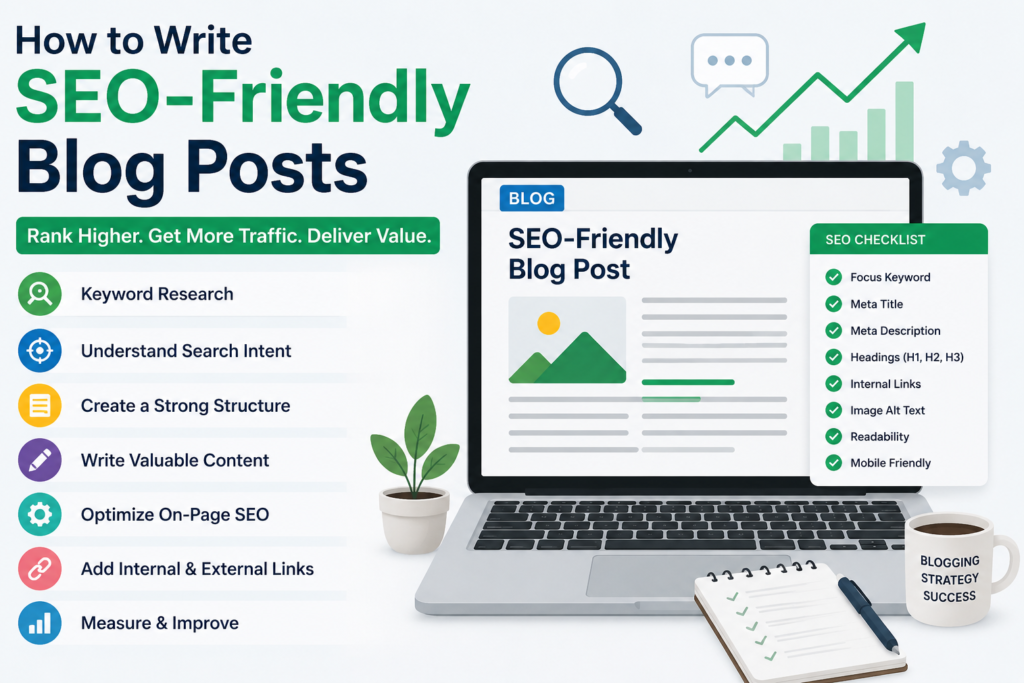
SEO-Friendly Blog Post Checklist
- Before publishing your article, review the following:
- Does the article satisfy the main search intent?
- Is the primary keyword relevant?
- Does the title clearly describe the content?
- Is there one clear H1?
- Are H2 and H3 headings logically organized?
- Does the introduction address the reader’s problem?
- Are keywords used naturally?
- Does the article provide original value?
- Are paragraphs easy to scan?
- Are relevant internal links included?
- Are images compressed and descriptive?
- Is the URL short and descriptive?
- Is the meta description useful?
- Does the page work well on mobile?
- Is the page reasonably fast?
- Have spelling and factual errors been checked?
- Is the article worth updating in the future?
Conclusion
Final Thoughts on Writing SEO-Friendly Blog Posts
Writing an SEO-friendly blog post is about much more than inserting keywords into an article. The most effective approach starts with understanding what users are searching for and why they are searching for it.
From there, choose a relevant keyword, analyze search intent, create a logical heading structure, write genuinely useful content, optimize important on-page elements, improve readability, add relevant internal links, and provide a strong overall user experience.
Most importantly, do not treat SEO as a one-time publishing task. Monitor how your content performs, identify areas for improvement, update outdated information, and continue creating content that solves real problems.
A successful SEO blog post should accomplish two things: help the reader and make the topic easy for search engines to understand. When those goals work together, your content has a much stronger foundation for sustainable organic visibility, traffic, and business growth. A Complete Guide
Writing a blog post that ranks well on Google is not simply about adding keywords to an article. Modern SEO requires content that answers the reader’s questions, provides genuine value, is easy to read, and helps search engines understand the topic.
An SEO-friendly blog post is created with both the user and search engine in mind. It should satisfy search intent, use relevant keywords naturally, have a clear structure, provide accurate information, and offer a better experience than competing pages.
Whether you are a beginner blogger, business owner, content marketer, or SEO professional, learning how to write SEO-friendly blog posts can help you attract organic traffic, build authority, and generate leads without depending entirely on paid advertising.
In this guide, you will learn how to research keywords, understand search intent, structure your content, optimize headings and URLs, write compelling introductions, improve on-page SEO, and measure your results.