
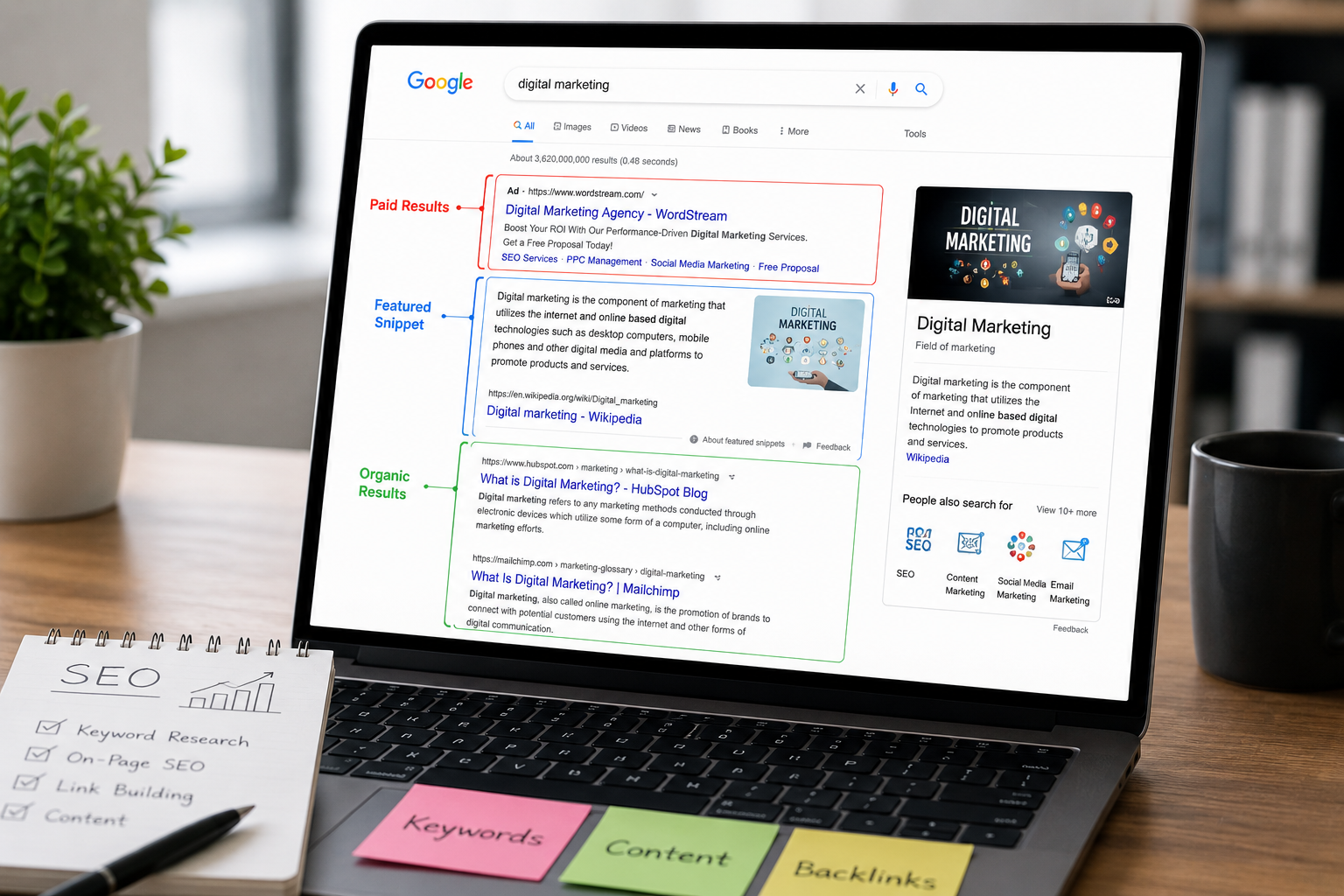
A Complete Guide to Search Engine Results Pages
What Is SERP in Digital Marketing ? When it comes to digital marketing, being visible to potential customers on search engines is significant. Whenever somebody searches for a product, service, question, or solution on Google or another search engine, the search engine presents a page that includes results that match their search. The page that appears is called the SERP (Search Engine Results Page).
Knowing SERPs’ workings is crucial for SEO professionals, content writers, business owners, and digital marketers as the presence on the first page can boost website visibility, traffic, leads, and conversions.
So, in this guide, we will cover the following: What SERP is in Digital Marketing, How it works, Its diverse features, why their SERP is important and how businesses can optimize their SERP ranking.
What Is SERP?
Search Engine Results Page (SERP) is the page that search engines display after you type in a query. The page a search engine presents to you once you put in a search query.
For instance, if someone searches for “best digital marketing course”, Google could show websites, ads, featured snippets, local business listings, videos, images, and more.
Several factors influence the results that appear on a SERP, such as:
The query entered by the user.
- Search intent
- Website relevance
- Content quality
- Website authority
- Location
- Device
- search history and personalization to target your audience.
- SEO performance
The primary purpose of the search engines is to deliver the most relevant and useful information to the users for their search queries.
Why Is SERP Important in Digital Marketing?
This is all the more crucial as SERP dictates how users find businesses and websites using search engines.
If a website is visible on the top of the search results, it is more likely to get organic traffic. The more visible your business becomes, the more visitors, enquiries, sales and brand awareness you will have.
1. Increases Website Visibility
The higher you are ranked on Google, the more noticeable you will be to potential customers. Google is the primary search engine for most users, making it important for businesses to be visible in the results of their search.For most users, the first stop for online research is a search engine, and being seen in the relevant results can help businesses reach their target audience.
2. Generates Organic Traffic
Organic search results can drive repeat traffic without businesses paying for each click. An effective SEO can help a website to appear for the keywords that are relevant to the website and has actually people that are looking for that type of information.
3. Builds Brand Awareness
If users keep seeing a brand included in the search results, they might become more familiar with the brand. Search visibility can help with brand recognition even if users don’t click on it.
4. Supports Lead Generation
Users who are interested in a product or service may find themselves on SERPs. Businesses can target commercial and transactional keywords, which will help them capture users who are closer to making a purchase.
5. Helps Improve SEO Strategy
Learning SERPs enables digital marketers to grasp the usefulness of a search engine in a specific query. Marketers can use this information to optimize their content for better ranking, understand how users interact with search results, and refine their strategies for engaging with the audience.This data can help marketers improve their SEO tactics, gain insights into user behavior, and create more effective strategies for reaching users.
What Are the Main Types of SERP Results?
People don’t use the blue links to navigate the Web. There are numerous SERP features.
1. Organic Search Results
Organic listings are ones that don’t have to be paid for by you as a company and show up because they are relevant to the searcher’s query.
A visitor looking up “how to learn SEO” can find blog posts, guides and educational material in the organic search results, for instance.
One of the biggest reasons why SEO experts spend so much time trying to get their site higher in the organic search results is because they can help them achieve long-term traffic.
2. Paid Search Results
Paid results are ads that appear on search engines. Search advertising allows businesses to pay for placements for certain keywords.
Sponsored or Ad” is the typical term used for paid ads.
The benefit of paid search is that it can give you instant visibility, whereas SEO is more time-dependent.
3. Featured Snippets
A featured snippet is a highlighted answer that appears prominently in the search results for some of the queries.
It may contain:
- A paragraph
- A list
- Steps
- A table
For instance, typing “what is SEO?” into the search engine might result in a concise explanation popping out in a featured snippet.
Well structured with clear and concise content can improve the chances of finding yourself in snippets-type queries.
4. People Also Ask
The related questions that users are often looking for are included in the People Also Ask (PAA) section.
For instance, if you search for ‘digital marketing,’ Google may present the following questions:
Digital marketing: What is it?
There are several different types of digital marketing.
What is the working of digital marketing?
Yes, you can build a good career in digital marketing.
Including answers to relevant questions, in the content, can help satisfy further user needs.
5. Local Pack
When there is a local intent, the local pack is displayed.
For instance, when people type in “digital marketing agency near me,” they might see local businesses, maps, ratings, addresses and more.
Local SEO is especially crucial for businesses with a geographical target market.
6. Image Results
Search engines may provide images search results when useful for searches.
Optimizing image file names, alt text, surrounding text and image quality can help to increase the likelihood of being discovered in image search.
7. Video Results
Video content also features on SERPs. Videos may be shown by search engines if the query can be answered well in video format.
Businesses can benefit from having more visibility by creating useful educational videos and optimizing their titles, descriptions and supporting information.
8. Shopping Results
Search engines might show shopping results with product pictures, prices, stores, and other details when searching for products.
These are significant findings for online retailers, particularly.
What Is SERP Ranking?
SERP (Search Engine Results Page) ranking is a web page’s rank in search engine results.
For instance, your page is showing up in #1 position in the natural search results list for a specific keyword, you have a high SERP position for that query.
The higher the ranking, the more visible the website is, but the potential traffic is also dependent on the search intent, competition, SERP features and attractiveness of the result.

Why Is the First Page Important?
Usually, the first page in the search results gets much more attention than subsequent pages. People tend to click the top links as they think they will be relevant and useful.
But the top ranking isn’t the only goal of SEO. The ultimate goal is to engage the right visitors to the site, to reach out to the business, or to buy a product.
In the end, just how does Google determine which results are shown on the SERP?
Search engines have complicated functions that decide which pages to show for a query.
There are some key factors to take into account:
Relevance
The content should be very similar to what the user is searching for.
Content Quality
Sometimes useful, accurate, original content can do better than thin or unhelpful content, if the content is well organized.
Search Intent
Search engines attempt to decipher what the user is searching for.
For instance, the search query “what is keyword research” is an informational query, whereas “buy SEO software” is a transactional query.
Website Authority
The overall reputation, quality and relevant references from the website can help with gaining the visibility in the search results.
User Experience
Mobile usability, page experience, navigation and website performance are just a few of the factors that can affect the quality of a webpage.
What Is Search Intent and Why Does It Matter for SERP?
Search intent is the reason behind a user’s search.
Content needs to meet the searcher’s intent, and this is one of the most significant aspects of SEO.
Informational Intent
Users want to learn something, they want it to be relevant to what they are doing.
Examples:
- What is SEO?
- What is keyword research?
- So what is SERP in Digital Marketing?
Navigational Intent
Users are looking for a particular site or page.
Examples:
- Google Search Console
- Facebook login
- YouTube
Commercial Investigation Intent
Users are researching before giving their decision.
Examples:
- Best SEO tools
- The best digital marketing courses on the market.
- SEO agency reviews
Transactional Intent
Users are poised to take action (e.g., purchase or sign up).
Examples:
- Buy SEO software
- There are various fees for digital marketing courses.Digital marketing course costs vary.
- Hire SEO agency
Aligning content with search intent can help boost the relevance of the content and bring in more relevant visitors.
SERP vs SEO: What Is the Difference?
While SERP and SEO go hand-in-hand, they are not synonymous.
Search engine results page (SERP) are the results that a search engine returns as a web page when you enter a query.
Implementing SEO (Search Engine Optimization) involves optimizing a website to receive increased visibility on search engine results.
For example:
The optimization process is SEO → Optimization process → Better search visibility → SERP appearance.
SEO is the method and SERP is the platform on which the results of the search are shown.
How to Improve Your SERP Ranking
There are a number of SEO strategies that can be employed for better search visibility of businesses.
## 1. Perform Keyword Research
Find keywords that people really use when searching. Know the intent behind search terms and how people will use them in their searches before developing content.
## 2. Create High-Quality Content
Create content that is answerable, informative and of value to users. Do not make content to fill in with keywords.
## 3. Optimize Title Tags
Your title should clearly and succinctly tell the user what the page contains and make them click.
For example:
So, what is SERP in digital marketing? Complete SEO Guide**
Is more descriptive than:
**SERP Guide**
## 4. Create helpful Meta Descriptions.
A meta description is a brief overview of a webpage. While it is not a ranking factor per se, a good description can get people to click on your result when it comes up.
## 5. Be sure to use Proper Heading Structure.
Organize content using H1, H2 and H3 headings. Users and search engines can more easily navigate the page.
## 6. Make sure that you optimize your content for Featured Snippets.
Use concise paragraph, step-by-step, bullet and well-organized information as appropriate to provide direct answers to commonly asked questions.
## 7. Improve Page Experience
Be sure that your website is:
- * Mobile-friendly
- * Easy to navigate
- * Fast and responsive
- * Secure
- * Easy to read
## 8. Build Relevant Backlinks
Relevant and trustworthy websites can provide quality backlinks that can boost a website’s authority and search engine visibility. Concentrate on building quality links instead of quantity of links.
## 9. Optimize for Local SEO.Local SEO Optimization.
Businesses with a local presence should fine-tune their local presence and ensure that they have accurate information about their business and develop local-relevant content.
## 10. Monitor SERP Performance
Track with SEO and search performance tools:
- Keyword rankings
- Organic clicks
- Impressions
- Click-through rate
- Search queries
- Pages receiving traffic
Consistent monitoring will identify opportunities for improvement.
What Is SERP Analysis?
One way to do SERP analysis is to look at the search results for a specific keyword to determine what kinds of pages and content are ranking.
Marketers can analyze before writing content:
- Top-ranking pages
- Search intent
- The length and organization of content.The quantity and structure of content.
- SERP features
- Related questions
- Competitors
- Content formats
- Keyword topics
For instance, if the keyword’s highest ranking results are detailed guides, then a 200-word article won’t meet the user’s need. The type of content users are expecting can be determined with SERP analysis.
Common SERP Mistakes to Avoid
Here are some common mistakes to avoid when submitting your site to Google SERPs.
## Keyword Stuffing
Overusing a keyword can cause content to be unnatural and low quality.
## Ignoring Search Intent
Producing the content that is not aligned with the user’s search intent can lead to low click-through rates, low engagement rates and poor search performance.
## Creating Thin Content
The pages that offer little useful content may not be able to compete with the thorough, informative resources.
## Focusing Only on Rankings
While ranking is crucial, traffic and conversions are also significant. Good traffic can be wasted on a high ranking page if it doesn’t attract the right visitors.
## Ignoring SERP Features
Nowadays, search visibility is not just about traditional organic results. Additional opportunities might include featured snippets, local, videos, images, shopping results and more.
How SERP Can Help a Digital Marketing Strategy
SERP data can provide valuable insights for marketers.
Through analyzing search results, marketers can find out what their competitors are doing, get an understanding of customer questions, see content opportunities, and optimize their keyword targeting.
If, for instance, users review comparison pages, read reviews and see pricing details for services they are looking for on a regular basis, a business can produce content that meets those demands.
This is why SERP analysis is a valuable tool for not just SEO but also for content marketing, PPC, local SEO, e-commerce, and conversion optimization.
Frequently Asked Questions About SERP
What does SERP stand for?
SERP is an acronym for Search Engine Results Page. It is the page that appears after the user types a query.
Is SERP the same as SEO?
No, SERP is the search results page and SEO is the action of optimising websites to make them more visible in the search results.
Why is SERP important for businesses?
SERP visibility can be a source for businesses to have organic traffic, grow brand awareness, create leads, and reach potential customers.
## What is a SERP feature?
A SERP feature is a search result element that does not look like a blue link, like a featured snippet, local pack, People Also Ask, shopping results, or image results.
How can I improve my SERP position?
Conduct keyword research, analyze search intent, develop valuable content, optimize on-page elements, enhance technical performance, acquire relevant backlinks, and regularly check search results.
Conclusion
The Search Engine Results Page, known as SERP, is a crucial term in the field of digital marketing and Search Engine Optimization (SEO). It’s the place where people find websites, businesses, products, videos, answers and other information online when they search for something.
By comprehending SERPs, marketers can gain insights into search intent, gauge competitor performance, uncover content opportunities, and enhance their strategies. The SERP has evolved to show more than just traditional organic results; it features featured snippets, local packs, People Also Ask, images, videos, shopping results and ads.
Don’t just optimize for keywords when trying to improve Website visibility. Rather, grasp the reason for people searching, what they’re looking for, and what sort of content is better suited to meet their needs.
By leveraging a robust SEO approach and conducting regular SERP analysis, businesses can gain a better understanding of their web pages’ position in search engine results and draw in more pertinent traffic, boost online visibility, foster leads, and secure sustained digital marketing success.