
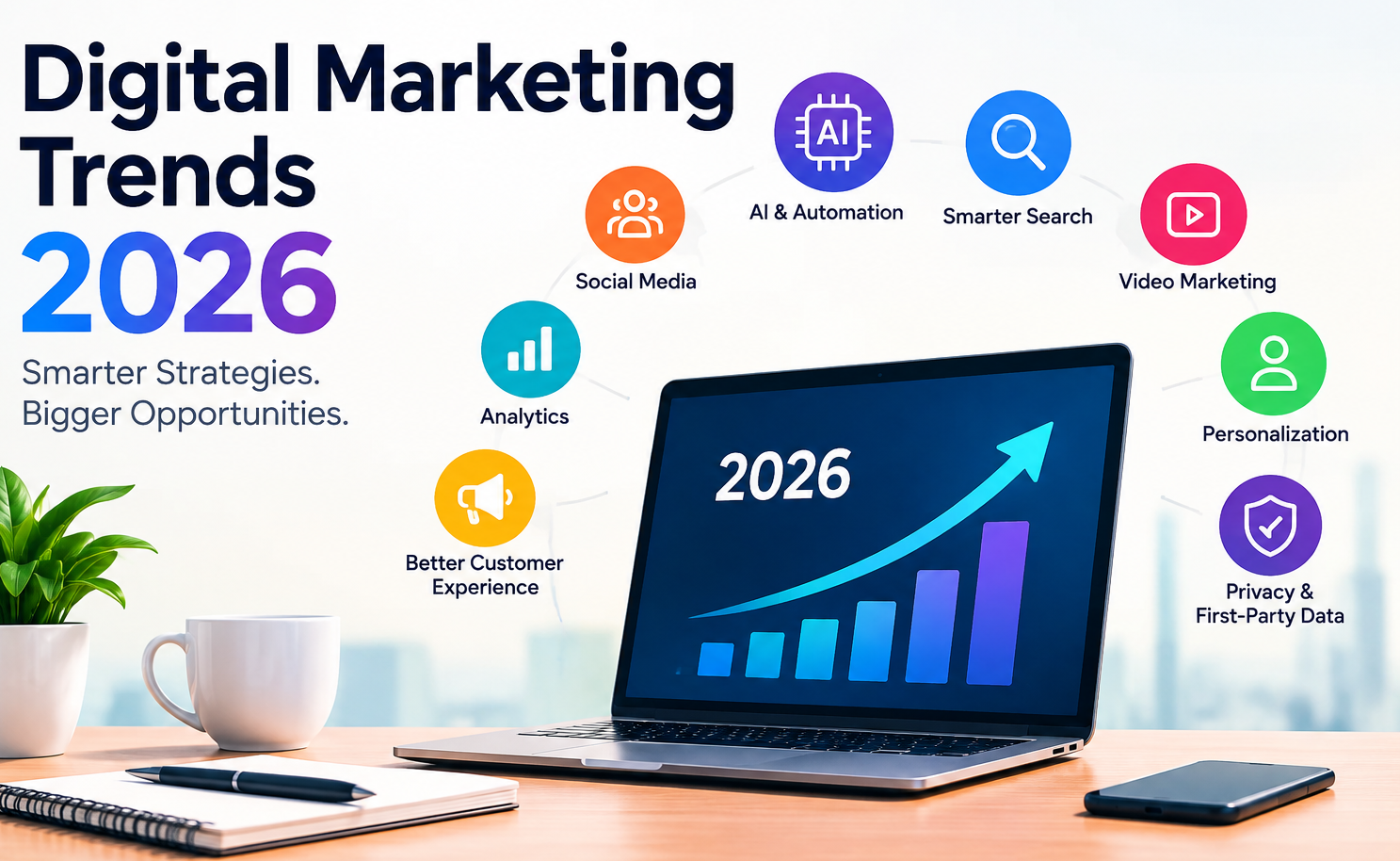
Digital marketing is changing faster than ever. New technologies, changing customer expectations, artificial intelligence, privacy regulations, and evolving search behavior are transforming how businesses attract and engage customers. Strategies that worked a few years ago may no longer deliver the same results in 2026.
For businesses, staying competitive is no longer simply about being active online. Companies need to understand where customers are searching, what content they trust, how AI is influencing marketing, and which digital experiences encourage people to take action.
The future of digital marketing is not about replacing traditional marketing with technology. It is about combining data, creativity, automation, and human understanding to create better customer experiences.
In this guide, we explore the most important digital marketing trends businesses need to know in 2026 and how companies can use them to improve visibility, generate leads, build trust, and increase conversions.
1. Artificial Intelligence Is Becoming a Core Marketing Tool
Artificial intelligence has moved from being an experimental technology to an important part of everyday marketing.
In 2026, businesses can use AI to support many marketing activities, including content planning, customer segmentation, campaign analysis, personalization, ad optimization, and customer support.
AI can process large amounts of information much faster than humans. This allows marketers to identify patterns and make more informed decisions.
However, businesses should not treat AI as a replacement for marketers.
The most effective approach is AI + human expertise.
AI can help generate ideas, analyze information, automate repetitive tasks, and identify opportunities. Human marketers still need to provide creativity, strategy, brand understanding, emotional intelligence, and quality control.
How businesses can use AI
Businesses can use AI to:
- Analyze customer behavior
- Generate content ideas
- Personalize marketing messages
- Improve advertising campaigns
- Automate repetitive tasks
- Predict customer interests
- Analyze campaign performance
- Support customer service
- Identify potential leads
The businesses that use AI strategically rather than simply producing large amounts of automated content are more likely to gain a competitive advantage.
2. Search Is Becoming More Conversational
Search behavior is changing.
People are increasingly asking complete questions instead of typing short keywords into search engines. AI-powered search experiences are also changing how users discover information.
Instead of searching for:
a user might ask:
“Which digital marketing strategy is best for a small business with a limited budget?”
This creates a major opportunity for businesses.
Brands should create content that directly answers customer questions instead of focusing only on inserting keywords into articles.
What businesses should do
Create content around:
- Frequently asked customer questions
- Problems customers want to solve
- Comparisons
- Step-by-step guides
- Product and service explanations
- Industry-specific questions
- Expert insights
The goal should be to become a useful source of information.
3. SEO Is Evolving Beyond Traditional Rankings
SEO remains important in 2026, but the definition of successful SEO is becoming broader.
Businesses should not focus only on ranking for individual keywords. They should also focus on helpfulness, relevance, authority, user experience, and visibility across different search experiences.
Modern SEO requires a strong combination of technical optimization and valuable content.
Important SEO priorities in 2026
Businesses should pay attention to:
- Search intent
- Helpful and original content
- Website speed
- Mobile experience
- Internal linking
- Technical SEO
- Structured information
- Brand authority
- Quality backlinks
- Local SEO
- Conversion optimization
A page that attracts thousands of visitors but fails to provide useful information or generate conversions may not create meaningful business value.
The future of SEO is therefore not just:
“How do I rank?”
It is:
“How do I become the most useful result for my target customer?”
4. Short-Form Video Will Remain Powerful
Short-form video has transformed digital marketing.
Platforms such as Instagram, YouTube, and other social platforms have made short videos an important way for brands to attract attention.
Consumers often prefer quick, visual explanations over long blocks of text.
Businesses can use short-form videos to explain products, demonstrate services, answer questions, share tips, introduce team members, and show behind-the-scenes activities.
Examples of short-form video content
A digital marketing agency could create videos such as:
- “3 SEO mistakes businesses make”
- “Why your Google Ads campaign is expensive”
- “One way to improve website conversions”
- “SEO tip of the day”
- “Digital marketing myth vs fact”
The key is not simply creating videos.
The content needs a strong hook, useful information, and a clear reason for viewers to continue watching.
5. Personalization Will Become More Important
Customers increasingly expect brands to understand their needs.
Generic marketing messages are easy to ignore. Personalized experiences can make communication more relevant.
For example, an online store may show different recommendations based on a visitor’s previous interactions. A service business may create different landing pages for different customer groups.
Personalization can be used in:
- Email marketing
- Website experiences
- Advertising
- Product recommendations
- Landing pages
- Content
- Customer communications
However, personalization should be balanced with privacy.
Businesses should use customer data responsibly and clearly communicate how information is being used.
6. First-Party Data Will Become More Valuable
Privacy changes are influencing how businesses collect and use customer information.
As reliance on third-party tracking becomes more complicated, companies need stronger first-party data strategies.
First-party data is information a business collects directly from its customers or audience through legitimate interactions.
Examples include:
- Email subscriptions
- Website interactions
- Customer purchases
- Contact forms
- Customer preferences
- Account activity
- Feedback
Businesses should focus on building genuine relationships instead of depending entirely on external platforms.
Why first-party data matters
It can help businesses:
- Understand customers
- Improve personalization
- Measure campaigns
- Build stronger relationships
- Develop better products
- Create targeted marketing campaigns
Trust is becoming an important part of data strategy.
7. Social Media Is Becoming a Search Engine
Many people now use social platforms to discover products, services, ideas, businesses, and recommendations.
This means businesses should think about social search, not just social posting.
A brand’s social media profile, videos, captions, hashtags, reviews, and comments can influence how people discover it.
Businesses should therefore optimize social content around topics customers are actually searching for.
For example, instead of posting:
“Our services are the best!”
a business could create:
“5 Digital Marketing Strategies Every Small Business Should Try in 2026.”
The second approach provides useful information and can attract people interested in solving a specific problem.
8. Influencer Marketing Is Becoming More Authentic
Influencer marketing continues to evolve.
Large follower counts do not automatically guarantee successful campaigns. Businesses are increasingly interested in creators who have strong relationships with specific communities.
Micro and niche creators can sometimes provide highly relevant audiences.
For businesses, the most important factors should include:
- Audience relevance
- Engagement
- Content quality
- Trust
- Brand alignment
- Campaign objectives
Instead of choosing an influencer simply because they have many followers, businesses should ask:
“Does this creator influence the type of people we want to reach?”
9. Voice and Visual Search Are Growing Opportunities
People are increasingly using voice assistants, image-based searches, and visual discovery tools.
This means businesses should make their digital content easy for search systems and users to understand.
For local businesses, this can be particularly important.
Accurate business information, useful website content, clear product descriptions, images, and local search optimization can improve discoverability.
Businesses should ensure that essential information such as:
- Business name
- Address
- Contact information
- Opening hours
- Services
- Product information
is accurate and consistent across relevant digital platforms.
10. Customer Experience Will Become a Major Competitive Advantage
Digital marketing does not end when someone clicks an advertisement.
The customer experience after the click matters just as much.
Imagine a company spends money on Google Ads and gets hundreds of visitors. But the website loads slowly, the message is confusing, and customers cannot easily find the contact form.
The advertising may generate traffic, but the overall marketing system fails to generate enough business.
That is why companies need to connect:
Advertising → Landing Page → Experience → Conversion → Follow-up

Every stage matters.
Businesses should regularly test their website experience and ask:
- Is the website easy to navigate?
- Is the value proposition clear?
- Does the page load quickly?
- Is the call-to-action easy to find?
- Does the website work well on mobile devices?
- Can customers easily contact the business?
11. Conversion Rate Optimization Will Matter More
Getting traffic is only one part of digital marketing.
The next question is:
What percentage of visitors actually take the desired action?
Conversion Rate Optimization, or CRO, focuses on improving the percentage of visitors who complete actions such as:
- Making a purchase
- Filling out a form
- Booking a consultation
- Calling a business
- Signing up for a newsletter
- Requesting a quote
Businesses can improve conversion rates through better headlines, clearer calls-to-action, simpler forms, stronger trust signals, better landing pages, and testing.
Even a small improvement in conversion rate can have a meaningful impact on business results.
12. Content Quality Will Matter More Than Content Quantity
AI makes it easier to create content at scale.
But more content does not automatically mean better marketing.
If businesses publish hundreds of generic articles that provide little original value, they may struggle to build trust or authority.
Successful content strategies should focus on:
Originality + Expertise + Relevance + Usefulness
Businesses should create content that adds something meaningful.
This could include:
- Original research
- Case studies
- Expert opinions
- Real examples
- Data analysis
- Practical tutorials
- Industry insights
- Customer experiences
The goal should be to create content people genuinely want to read, save, share, or use.
13. Interactive Content Will Increase Engagement
People do not always want to passively consume content.
Interactive experiences can encourage users to participate.
Businesses can experiment with:
- Quizzes
- Calculators
- Polls
- Assessments
- Interactive tools
- Surveys
- Product configurators
For example, a digital marketing company could create a simple marketing assessment that helps businesses identify potential weaknesses in their online strategy.
Interactive content can also provide useful insights about customer needs.
14. Digital Advertising Will Become More Data-Driven
Paid advertising platforms are becoming increasingly automated.
Businesses can use platforms such as Google Ads and social advertising platforms to reach specific audiences and optimize campaigns.
But automation does not remove the need for strategy.
Businesses still need strong:
- Offers
- Creative
- Landing pages
- Audience understanding
- Conversion tracking
- Campaign objectives
A successful advertising strategy should focus on business outcomes rather than simply maximizing clicks.
For example, a company should measure whether advertising generates qualified leads or sales—not just how many people clicked the advertisement.
15. Marketing Analytics Will Focus on Business Results
In 2026, businesses need to move beyond vanity metrics.
Metrics such as likes, followers, and impressions can provide useful context, but they do not always show business performance.
Companies should connect marketing activity to meaningful outcomes.
Important metrics can include:
- Cost per lead
- Conversion rate
- Customer acquisition cost
- Return on advertising spend
- Revenue generated
- Customer lifetime value
- Qualified leads
- Sales opportunities
The exact metrics will depend on the business model.
The important principle is simple:
Measure what matters to the business.
16. Community Building Will Become More Valuable
Customers do not always want to feel like they are being marketed to.
They want useful information, conversations, experiences, and relationships.
This is why community building can become an important part of digital marketing.
Businesses can build communities through:
- Social media groups
- Email newsletters
- Online events
- Webinars
- Customer communities
- Educational content
- Industry discussions
A strong community can increase trust and encourage repeat engagement.
17. Human Creativity Will Still Matter
With AI becoming more powerful, one question remains:
Will human creativity still matter?
Absolutely.
Technology can help businesses produce and analyze information, but customers still respond to stories, emotions, experiences, humor, trust, and authentic communication.
The strongest marketing strategies in 2026 will likely combine technology with human creativity.
AI can help marketers work faster.
Humans help determine:
What should we say? Why should we say it? Who needs to hear it? And how should the brand make people feel?
How Businesses Can Prepare for the Future of Digital Marketing
Businesses do not need to adopt every new trend immediately.
Instead, they should build a flexible digital marketing strategy.
Step 1: Understand Your Audience
Identify your target customers, their problems, their questions, and their buying behavior.
Step 2: Strengthen Your Website
Your website should be fast, mobile-friendly, easy to navigate, and focused on conversions.
Step 3: Build a Strong Content Strategy
Create useful content that answers customer questions and demonstrates expertise.
Step 4: Use AI Strategically
Use AI to improve productivity, analysis, personalization, and campaign optimization while maintaining human oversight.
Step 5: Invest in SEO and Search Visibility
Optimize your website and content for both traditional search and emerging search experiences.
Step 6: Experiment With Video
Create short, useful videos that educate, entertain, or solve customer problems.
Step 7: Track Meaningful Results
Connect marketing activities to leads, sales, revenue, and customer value.
Step 8: Build Customer Trust
Be transparent about data, provide valuable information, and maintain consistent brand communication.
Conclusion
The future of digital marketing in 2026 is not defined by one platform, one technology, or one marketing tactic. It is being shaped by a combination of artificial intelligence, changing search behavior, personalization, privacy, video, SEO, social media, analytics, and customer experience.
Businesses that want to remain competitive need to become more adaptable.
AI will continue to transform how marketers work. Search will become more conversational and intelligent. Social platforms will increasingly influence discovery. Short-form video will continue to capture attention. First-party data will become more important. At the same time, customers will continue to expect relevant, useful, trustworthy, and convenient experiences.
The biggest opportunity for businesses is to connect these trends into one clear strategy.
Instead of asking, “Which digital marketing trend should we follow?”, businesses should ask:
“Which trends can help us solve our customers’ problems and achieve measurable business results?”
That shift in thinking is important.
Digital marketing should not be about chasing every new feature or platform. It should be about understanding customers, delivering value, building trust, and continuously improving performance.
Businesses that combine technology with human creativity, data with strategy, and automation with genuine customer understanding can create stronger digital experiences.
The future belongs to businesses that are willing to learn, test, adapt, and improve.
In 2026 and beyond, successful digital marketing will not simply be about getting attention. It will be about turning that attention into trust, relationships, leads, customers, and long-term growth.