
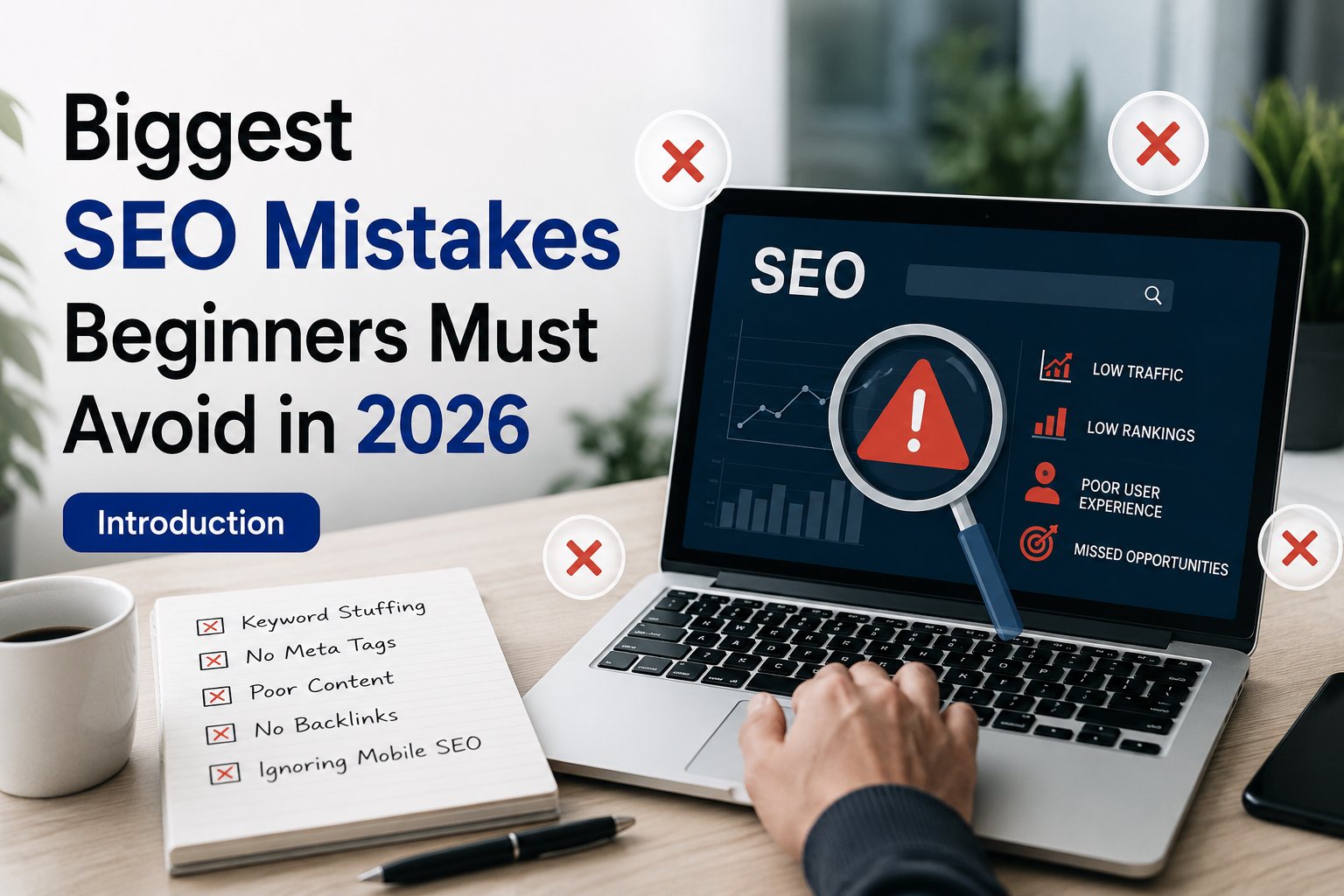
Introduction
Biggest SEO Mistakes Beginners Must Avoid in 2026 Search Engine Optimization (SEO) is one of the most effective digital marketing strategies for driving long-term organic traffic. Whether you own a business website, run a blog, or manage an Commerce store, ranking on search engines like Google can significantly increase your visibility, leads, and sales Biggest SEO Mistakes Beginners Make
However, many beginners make common SEO mistakes that prevent their websites from ranking well. They often focus on outdated techniques, ignore technical SEO, publish low-quality content, or neglect user experience. Even a few small mistakes can hurt your rankings and reduce your chances of appearing on the first page of Google.
The good news is that most SEO mistakes are completely avoidable. By understanding these common errors and following SEO best practices, beginners can build a strong foundation for long-term success.
In this guide, we’ll explore the biggest SEO mistakes beginners make, why they matter, and how you can avoid them to improve your website’s search engine rankings.
Why Avoiding search engine optimization Mistakes Is Important
SEO isn’t just about adding keywords to your content. Modern SEO focuses on providing valuable information, improving website performance, and creating an excellent user experience.
Avoiding search engine optimization mistakes helps you:
- Increase organic traffic
- Improve Google rankings
- Build website authority
- Generate more leads
- Improve user engagement
- Reduce bounce rates
- Achieve long-term online growth
Even the best content won’t rank if your website has major SEO issues.
1. Ignoring Keyword Research
One of the biggest beginner mistakes is writing content without researching keywords.
Many people create articles based only on assumptions instead of understanding what users are actually searching for.
Common Problems
- Targeting keywords with extremely high competition
- Choosing irrelevant keywords
- Ignoring search volume
- Not understanding search intent
How to Fix It
Use keyword research tools like:
- Google Keyword Planner
- Google Search Console
- Ahrefs
- SEMrush
- Ubersuggest
Choose keywords that have:
- Good search volume
- Low to medium competition
- High relevance
- Clear search intent
Always include your primary keyword naturally throughout your content.
2. Keyword Stuffing
Years ago, repeating keywords helped rankings.
Today, keyword stuffing is considered spam.
Bad Example
Best SEO company provides best SEO services because our SEO company offers best SEO services for SEO clients.
Google easily identifies this type of content.
Better Approach
Use:
Write for humans first, search engines second.
3. Publishing Thin or Low-Quality Content
Google rewards content that genuinely helps users.Biggest SEO Mistakes Beginners Make
Many beginners publish:
- 300-word articles
- AI-generated content without editing
- Duplicate information
- Articles with little value
High-Quality Content Should Include
- Detailed explanations
- Original insights
- Practical examples
- Images
- FAQs
- Statistics
- Internal links
Long-form, informative content generally performs much better than short, generic articles.
4. Ignoring Search Intent
Search intent is one of Google’s biggest ranking factors.
If your content doesn’t satisfy what users are looking for, it won’t rank well.
‘* Types of Search Intent
Informational
Example:
(a) “What is search engine optimization ?
Commercial
Example:
(b) “Best search engine optimization tools“
Transactional
Example:
(c) “Buy search engine optimization software”
Navigational
Example:
(d) “Google Search Console login”
Always match your content to the user’s intent.
5. Writing Poor Meta Titles and Descriptions
Many beginners either skip metadata or write generic titles.
Poor Title
search engine optimization Tips
Better Title
15 Biggest search engine optimization Mistakes Beginners Make (And How to Avoid Them)Biggest SEO Mistakes Beginners Make
Your meta title should:
- Include the primary keyword
- Stay under 60 characters
- Encourage clicks
Meta descriptions should:
- Be around 150–160 characters
- Summarize the page
- Include the keyword naturally
6. Not Optimizing Images
Images improve user experience, but poorly optimized images slow down websites.
Common Mistakes
- Large image files
- Missing ALT text
- Generic filenames
- No compression
Best Practices
- Compress images
- Use WebP format
- Add descriptive ALT text
- Rename files using keywords
- Enable lazy loading
Image optimization improves both SEO and page speed.
7. Poor Website Speed
Google considers page speed a ranking factor.
Slow websites frustrate users and increase bounce rates.
Causes
- Large images
- Poor hosting
- Too many plugins
- Heavy JavaScript
- No caching
Improve Speed By
- Compressing images
- Using CDN
- Enabling browser caching
- Minimizing CSS and JavaScript
- Choosing quality hosting
A faster website improves both rankings and user experience.
8. Ignoring Mobile Optimization
Most Google searches happen on mobile devices.
If your website isn’t mobile-friendly, rankings may suffer.
Common Problems
- Small fonts
- Broken layouts
- Buttons too close together
- Slow mobile speed
Responsive website design is now essential for SEO success.
9. Forgetting Internal Linking
Internal links help search engines understand your website structure.
Benefits include:
- Better crawling
- Improved user navigation
- Increased page authority
- Longer session duration
Link related articles whenever possible.
Example:
If you’re writing about SEO mistakes, link to:
- On-page SEO
- Technical SEO
- Keyword research
- Content marketing
10. Not Building High-Quality Backlinks
Backlinks remain one of Google’s strongest ranking signals.
Many beginners:
- Buy spammy backlinks
- Use link farms
- Ignore link building completely
Focus on earning quality backlinks through:
- Guest posting
- Valuable content
- Digital PR
- Resource pages
- Industry partnerships
Quality always beats quantity.
11. Neglecting Technical SEO
Technical SEO helps search engines crawl and index your website efficiently.
Important areas include:
- XML Sitemap
- Robots.txt
- HTTPS
- Canonical URLs
- Structured Data
- Crawl errors
- Broken links
Technical issues can prevent even great content from ranking.
12. Duplicate Content
Duplicate content confuses search engines.
Common causes include:
- Copying blogs
- Reusing product descriptions
- Multiple URLs for the same page
Always create unique content.
If duplicate pages are necessary, use canonical tags.
13. Ignoring User Experience (UX)
Google increasingly measures user satisfaction.
Poor UX includes:
- Difficult navigation
- Too many ads
- Slow loading
- Poor readability
- Pop-ups everywhere
Improve UX by:
- Using headings
- Short paragraphs
- White space
- Clear navigation
- Readable fonts
Happy users usually lead to better rankings.
14. Not Updating Old Content
SEO is not a one-time task.
Old articles can lose rankings over time.
Update content regularly by:
- Adding new information
- Updating statistics
- Fixing broken links
- Refreshing screenshots
- Improving readability
Fresh content often performs better in search results.
15. Ignoring Google Search Console
Many beginners never connect their website to Google Search Console.
This free tool provides valuable insights into:
- Keyword rankings
- Click-through rates
- Indexing issues
- Mobile usability
- Core Web Vitals
- Crawl errors
Checking Search Console regularly helps identify SEO opportunities and fix issues before they impact rankings.
SEO Best Practices Every Beginner Should Follow
To build a strong SEO foundation, follow these best practices:Biggest SEO Mistakes Beginners Make
- Conduct keyword research before writing.
- Create helpful, original, and in-depth content.
- Focus on search intent rather than keyword density.
- Optimize titles, meta descriptions, and headings.
- Improve page speed and mobile responsiveness.
- Use descriptive image ALT text.
- Build a logical internal linking structure.
- Earn high-quality backlinks naturally.
- Fix technical SEO issues regularly.
- Track performance with Google Search Console and analytics tools.
- Update old content to keep it relevant.
- Prioritize user experience across every page.
Consistently applying these practices will improve your site’s visibility and help you achieve sustainable organic growth.
SEO Best Practices Every Beginner Should Follow
To build a strong SEO foundation, remember these best practices:
- Research keywords before creating content.
- Write original, valuable, and in-depth articles.
- Optimize title tags, meta descriptions, and headings.
- Improve website loading speed and mobile responsiveness.
- Use descriptive URLs and image alt text.
- Build a logical internal linking structure.
- Earn high-quality backlinks naturally.
- Perform regular technical SEO audits.
- Update older content to keep it relevant.
- Track your SEO performance and refine your strategy based on data.
By consistently following these practices, you can avoid common mistakes and improve your chances of ranking higher in search engine results.
Conclusion
SEO success doesn’t happen overnight, and beginners often make mistakes simply because they’re still learning. The most common SEO mistakes include poor keyword research, keyword stuffing, low-quality content, ignoring search intent, weak technical SEO, slow website speed, missing mobile optimization, duplicate content, poor internal linking, and neglecting user experience.
The good news is that every one of these mistakes can be corrected. By focusing on high-quality content, understanding your audience, optimizing your website technically, and following Google’s best practices, you’ll build a strong SEO foundation that delivers long-term results.
Remember, SEO is an ongoing process—not a one-time task. Keep monitoring your website, updating your content, and adapting to search engine algorithm changes. With patience, consistency, and the right strategy, even beginners can achieve higher rankings, attract more organic traffic, and grow their online presence successfully.