Introduction
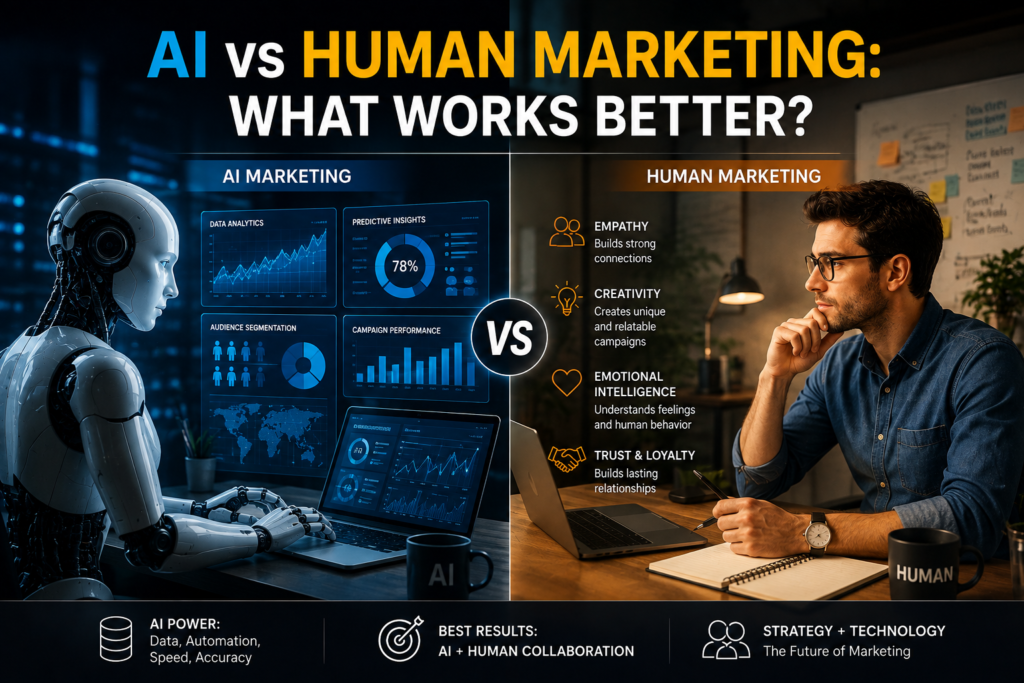
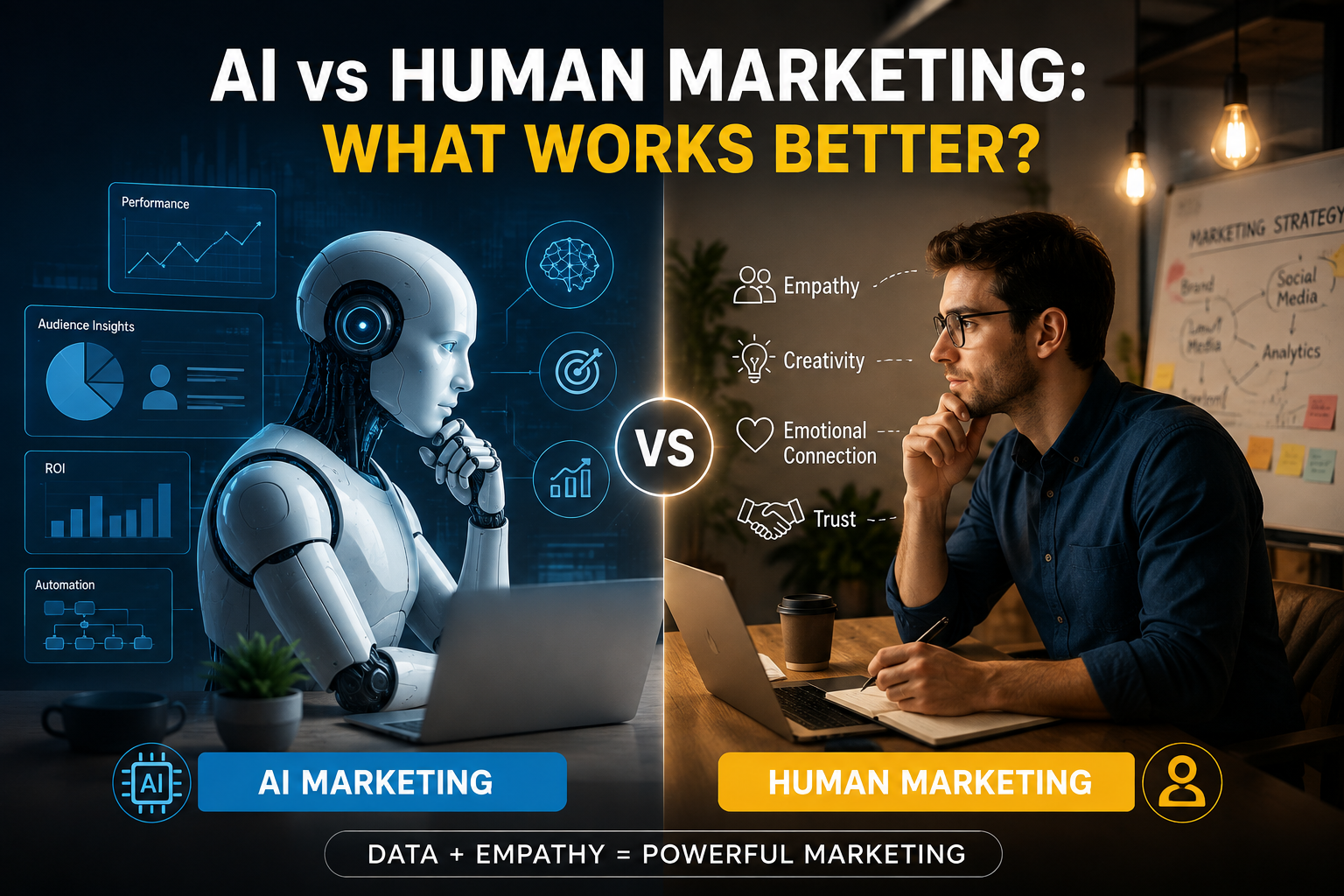
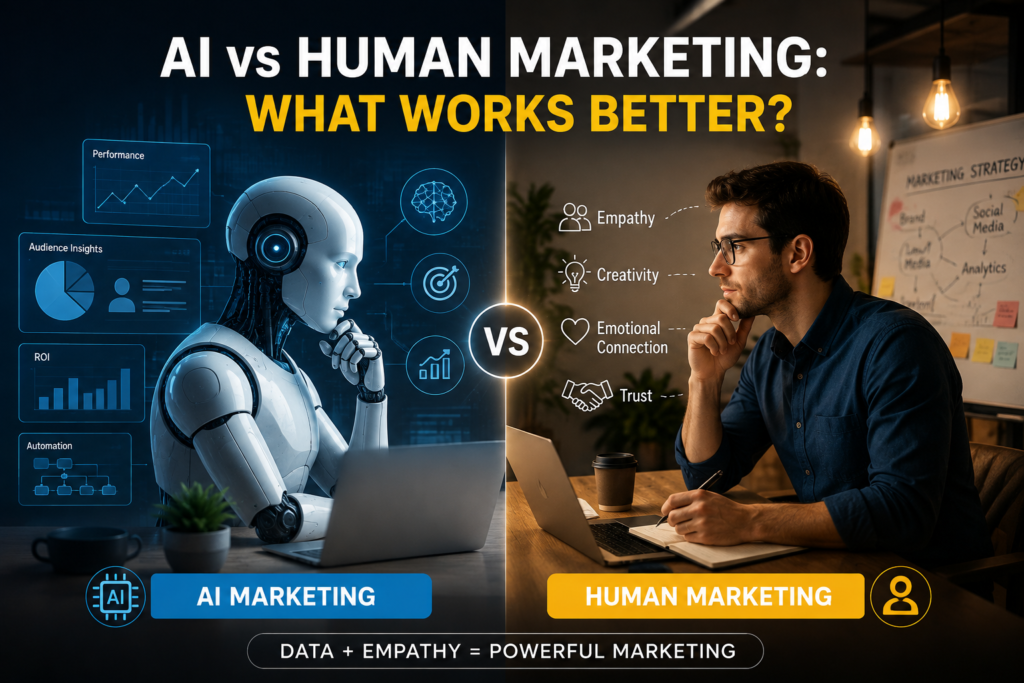
AI vs Human Marketing: Artificial Intelligence (AI) has transformed digital marketing faster than almost any other technology in recent years. From writing blog posts and creating social media captions to optimizing ad campaigns and analyzing customer behavior, AI has become an essential tool for businesses of all sizes. As AI continues to evolve in 2027, many marketers are asking an important question: AI vs Human Marketing: What Works Better?
The answer isn’t as simple as choosing one over the other. While AI offers incredible speed, automation, and data analysis, human marketers bring creativity, emotional intelligence, strategic thinking, and authentic storytelling that machines cannot fully replicate.
Businesses that rely only on AI may produce content quickly but risk sounding generic or disconnected from their audience. On the other hand, businesses that ignore AI may struggle to keep up with competitors who are using automation to save time and improve efficiency.
In this guide, we’ll compare AI marketing and human marketing, explore their strengths and weaknesses, and explain why the future belongs to businesses that combine both.
What Is AI Marketing?
AI marketing uses artificial intelligence technologies to automate, optimize, and improve marketing activities. AI can analyze large datasets, identify patterns, generate content, predict customer behavior, and optimize campaigns with minimal human intervention.
Common AI marketing applications include:
- AI content writing
- Email automation
- Chatbots
- Predictive analytics
- Customer segmentation
- Social media scheduling
- Ad optimization
- SEO recommendations
- Image generation
- Video creation
- Marketing automation
- Personalized product recommendations
AI helps marketers work faster while making data-driven decisions.
What Is Human Marketing?
Human marketing relies on creativity, experience, emotional intelligence, and strategic decision-making. Human marketers understand customer emotions, cultural trends, and brand identity in ways AI cannot fully replicate.
Human marketers are responsible for:
- Brand strategy
- Creative campaigns
- Storytelling
- Customer relationships
- Crisis management
- Negotiation
- Public relations
- Ethical decision-making
- Marketing leadership
- Business strategy
Successful marketing still depends on understanding people, not just data.
Strengths of AI Marketing
1. Speed
AI completes tasks in seconds that might take humans hours.
Examples include:
- Writing product descriptions
- Creating ad copy
- Keyword research
- Data analysis
- Customer segmentation
This allows businesses to scale their marketing efforts efficiently.
2. Data Analysis
AI can process millions of data points quickly.
It identifies:
- Customer behavior
- Buying trends
- Popular products
- Best-performing ads
- Conversion opportunities
These insights help marketers make informed decisions.
3. Automation
AI automates repetitive tasks such as:
- Email campaigns
- Lead nurturing
- Social media posting
- Customer support
- Reporting

Automation saves time and reduces manual effort.
4. Personalization
AI can deliver personalized experiences based on user behavior.
Examples include:
- Product recommendations
- Personalized emails
- Dynamic website content
- Customized advertisements
Personalization often leads to higher engagement and conversions.
5. Cost Efficiency
Businesses can reduce operational costs by automating repetitive marketing tasks.
Small businesses benefit because they can achieve more with limited resources.
Weaknesses of AI Marketing
Despite its strengths, AI has limitations.
Lack of Creativity
AI generates content based on existing patterns.
It rarely creates groundbreaking ideas or original campaigns.
1. Limited Emotional Understanding
AI struggles to understand:
- Humor
- Cultural differences
- Empathy
- Human emotions
- Complex relationships
Marketing often requires emotional connections that AI cannot fully replicate.
2. Generic Content
Without proper guidance, AI-generated content may sound repetitive and lack a unique brand voice.
Human editing is often necessary to maintain quality and authenticity.
3. Ethical Challenges
AI can unintentionally produce misleading, biased, or inaccurate content if not properly supervised.
Businesses must review AI outputs carefully before publishing.
Strengths of Human Marketing
1. Creativity
Human marketers develop unique ideas, memorable campaigns, and compelling stories.
Creativity remains one of the biggest competitive advantages in marketing.
2. Emotional Intelligence
Humans understand customer emotions, motivations, and concerns.
This helps create marketing messages that resonate on a deeper level.
3. Strategic Thinking
Marketing involves long-term planning.
Human marketers consider:
- Market trends
- Brand positioning
- Competitive analysis
- Business objectives
Strategic decisions require context and judgment beyond data alone.
4. Authentic Storytelling
Customers connect with authentic experiences.
Human marketers create stories that build trust, loyalty, and emotional engagement.
Strong storytelling makes brands more memorable.
Business growth depends on strong relationships.
Humans excel at:
- Customer service
- Networking
- Partnerships
- Community building
- Negotiation
These interpersonal skills remain essential.
Weaknesses of Human Marketing
Human marketing also has challenges.
(a) Slower Execution
Manual tasks require more time than automated systems.
Large campaigns may take weeks to complete.
(b)Higher Costs
Hiring experienced marketers, designers, writers, and analysts can be expensive.
Smaller businesses may struggle with limited budgets.
(c ) Human Error
People can make mistakes in:
- Data analysis
- Campaign management
- Content creation
- Reporting
AI tools can help reduce these errors through automation.
AI vs Human Marketing Comparison
| Feature | AI Marketing | Human Marketing |
| Speed | Excellent | Moderate |
| Creativity | Limited | Outstanding |
| Emotional Intelligence | Weak | Excellent |
| Data Analysis | Excellent | Good |
| Automation | Excellent | Limited |
| Strategic Thinking | Limited | Excellent |
| Storytelling | Basic | Powerful |
| Customer Relationships | Limited | Strong |
| Cost Efficiency | High | Moderate |
| Innovation | Moderate | High |
The comparison shows that each approach has unique strengths. Choosing the right balance depends on your goals, audience, and resources.
Where AI Performs Better
AI is particularly effective for:
- SEO analysis
- Keyword research
- Marketing automation
- Data reporting
- Email workflows
- Ad optimization
- Customer segmentation
- Predictive analytics
- Content drafts
- Performance monitoring
These tasks are repetitive, data-heavy, and benefit from automation.
Where Humans Perform Better
Human marketers excel at:
- Brand storytelling
- Creative advertising
- Emotional campaigns
- Crisis communication
- Business strategy
- Relationship management
- Customer experience
- Public speaking
- Community engagement
- Leadership
These activities rely on empathy, judgment, and creativity.
The Best Approach: AI + Human Collaboration
The most successful marketing teams in 2027 combine AI efficiency with human expertise.
A practical workflow might look like this:
- Use AI to research keywords and market trends.
- Let AI generate a first draft of content.
- Have a human editor refine the message, add insights, and ensure brand consistency.
- Use AI to optimize the content for SEO.
- Let humans manage customer interactions and community engagement.
- Analyze campaign performance with AI and use human judgment to improve future strategies.
This collaboration delivers speed without sacrificing quality.
Tips for Businesses
To get the most from AI and human marketing:
- Use AI for repetitive tasks, not final decision-making.
- Keep humans involved in strategy and creative work.
- Review AI-generated content before publishing.
- Maintain a consistent brand voice.
- Invest in employee training on AI tools.
- Prioritize transparency and ethical AI use.
- Measure campaign performance regularly.
- Stay updated with emerging AI technologies.
These practices help businesses maximize efficiency while preserving authenticity.
Future of Marketing
The future of marketing is not AI replacing humans—it is AI empowering humans.
As AI continues to improve, marketers will spend less time on repetitive tasks and more time on creativity, innovation, and relationship building. Businesses that successfully integrate AI into their workflows while maintaining a human-centered approach will be better equipped to adapt to changing customer expectations and market trends.
Consumers will continue to value authenticity, trust, and meaningful experiences. Brands that combine advanced technology with genuine human connection will stand out in an increasingly competitive digital landscape.
Conclusion
So, AI vs Human Marketing: What Works Better? The answer is that neither works best on its own. AI brings unmatched speed, automation, personalization, and data analysis, while human marketers provide creativity, emotional intelligence, strategic thinking, and authentic storytelling.
The strongest marketing strategies in 2027 blend the strengths of both. Use AI to streamline repetitive tasks, uncover insights, and improve efficiency, but rely on human expertise to shape brand identity, connect with audiences, and make critical decisions.
Businesses that embrace this balanced approach will create more effective campaigns, build stronger customer relationships, and achieve sustainable growth in the evolving world of digital marketing.