How Long Does SEO Take? 5 Powerful Facts? If you’ve recently invested in SEO, one of the questions you are likely to ask is: How long does it take SEO to work?
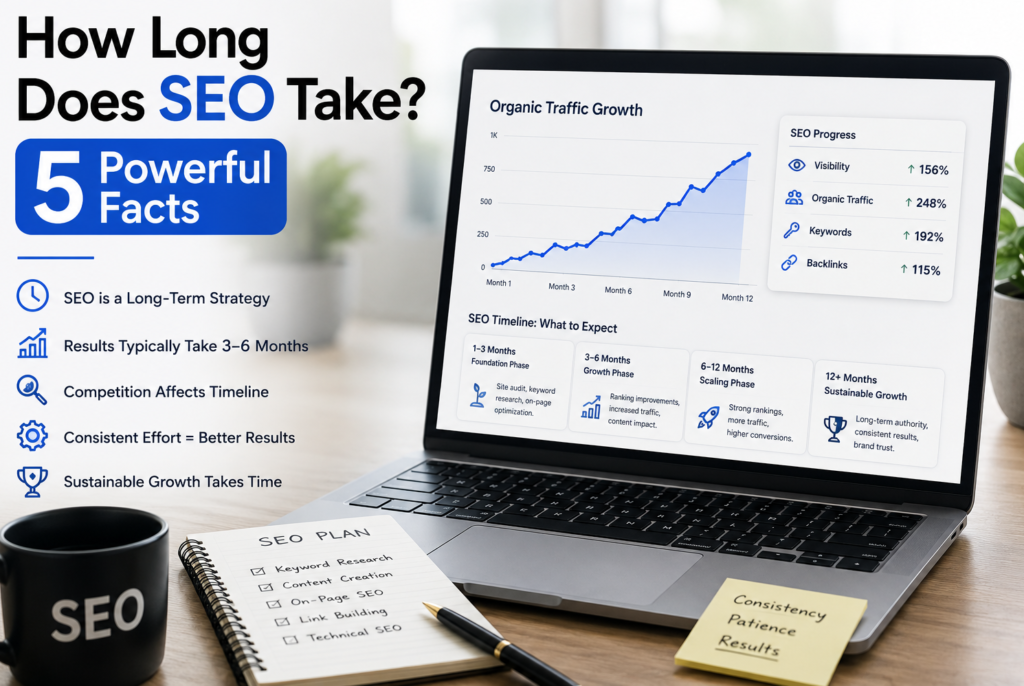
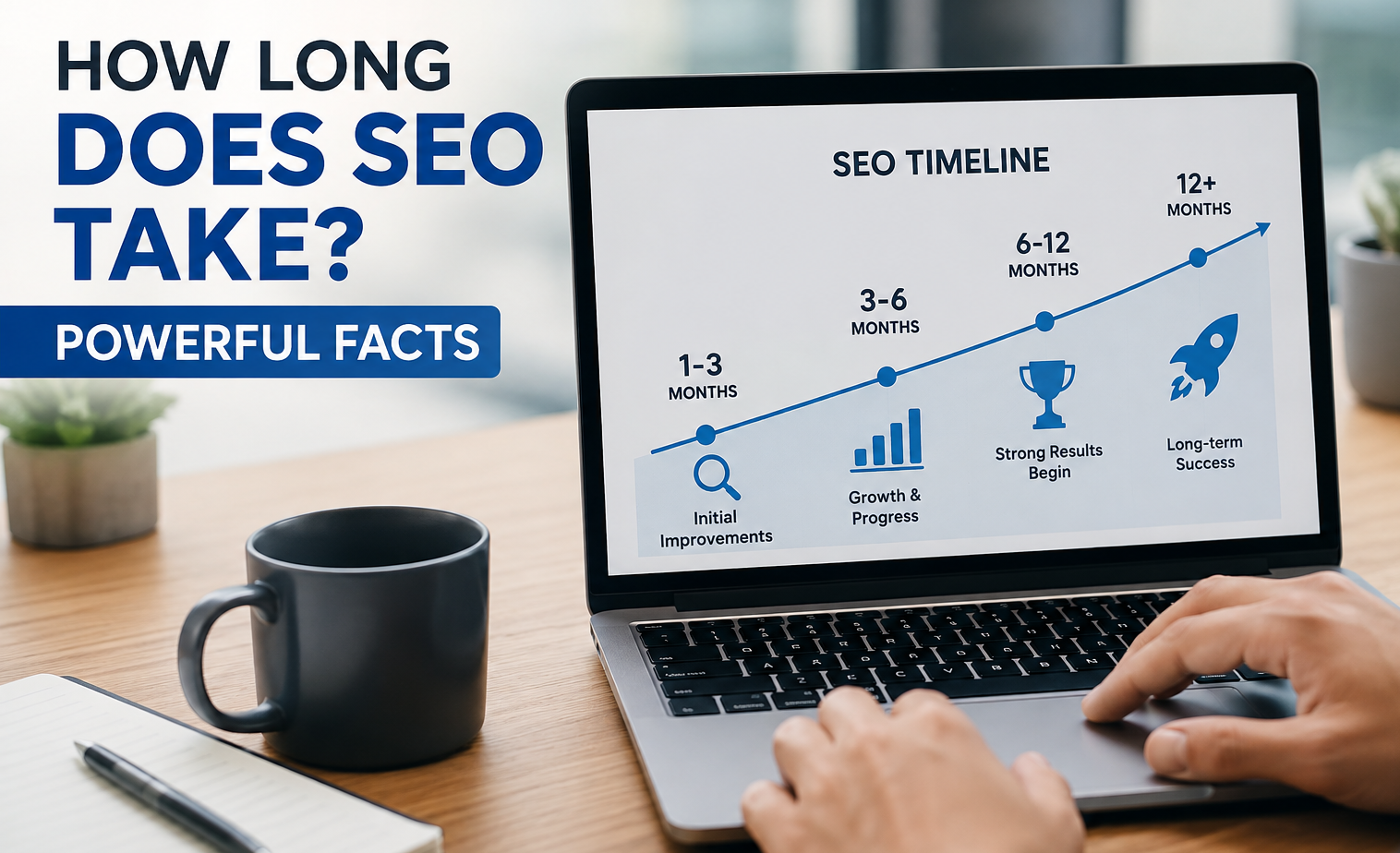
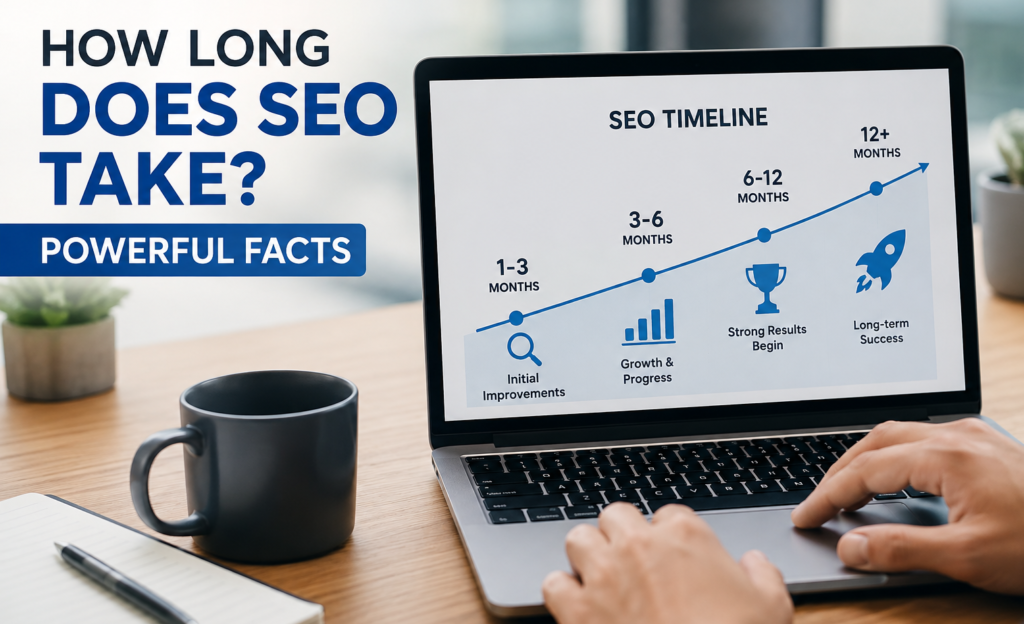
So, the truth is that SEO doesn’t work overnight. In most cases, initial improvements will be seen in 3 to 6 months, and more robust and sustained results in 6 to 12 months or beyond.

But there is no definite time scale for each site. This depends on the website’s condition, competition, industry, content quality, technical SEO, backlinks, website authority and the SEO strategy employed.
Knowing these things can help you avoid common SEO pitfalls and have realistic expectations.
What Is SEO?
Search Engine Optimization simply put refers to the process of optimizing a website for higher ranking in search engine results.
As people look for products, services or information related to your business, SEO helps your website to be more visible.
For instance, a digital marketing firm can target keywords like:
- Digital marketing services
- SEO services
- Website development services
- Digital marketing company in Kurukshetra
- SEO company in Haryana
The objective isn’t just about driving more traffic. A good SEO strategy is all about attracting the right visitors that are more likely to become customers.
So how long will SEO take?
SEO generally takes about 3 to 6 months for a new website or an average website to see visibility, and 6 to 12 months or more to see significant growth.
This doesn’t imply that nothing occurs within the first few months.
SEO enhancements may take place slowly:
Month 1:
Website audit, keyword research and technical optimizations.Month 1: Website and SEO audit, keyword research, technical optimizations.
Month 2:
On page optimization and content optimization, internal linking.
Month 3:
The new content starts getting visibility and impressions.
The month 4–6
period can begin to see rankings and organic traffic start to increase. Rankings and organic traffic can begin to improve at around
month 4–6.
A significant improvement in rankings, traffic, leads, and authority can be built in months 6–12.
Other sites may give you quicker results and more competitive sites may take more time.
What Makes SEO So Slow?
SEO is not a quick process as it involves search engines to find, crawl, understand and evaluate changes made to a website.
As soon as you publish a new page, it doesn’t simply skyrocket to number one on Google’s list.
There are many factors that search engines Digital marketing take into account when deciding which pages to show for a specific search query.
These can include:
- Content relevance
- Content quality
- Website authority
- Search intent
- Technical SEO
- Internal links
- External links
- User experience
- Competition
- Website history
- Local relevance
SEO is, in turn, not a one-time undertaking, but a long-term process.
1. Your Website’s Age Matters
A newly created website will take longer to build up authority than a website established website.
If you already have:
- Indexed pages
- Backlinks
- Search visibility
- Brand recognition
- Existing traffic
- Content history
A new website has minimal or no search ranking.
But it isn’t impossible for new sites to get rankings. Simply, it indicates that they might require
a more potent approach and patience.
2. Site Reputation is Destroyed by the competition
How quickly SEO can work is heavily dependent on competition.
When you want to rank for a particular keyword, you can do so on a specific page.
“Digital marketing services”
can be much more difficult than ranking for:
“Small businesses digital marketing services in Kurukshetra.”
The broad phrases tend to be more competitive.
Smaller companies can sometimes have a chance at getting seen quicker with long-tail and
location-specific keywords.
Prior to the implementation of SEO practices, businesses ought to analyze:
Keyword competition
- Search intent
- Competitor websites
- Content quality
- Domain authority
- Backlink profiles
- Local competition
This makes a realistic SEO time frame.
3. Your Industry Makes a Difference
There are very competitive online industries.
For example, keywords related to:
to:
- Insurance
- Finance
- Real estate
- Healthcare
- E-commerce
- Software
- Digital marketing
There’s a lot of competition when it comes to canned vegetables for nutritional purposes.
A smaller, local business might be able to get some results quicker if it focuses on specific local keywords and niche searches.
An example of this is that a local service provider may have a better chance with:
“Web Development Company in Kurukshetra”
more than with the significantly larger keyword:
“Website development company.”
4. Technical SEO can help to accelerate progress.
Content and backlinks are not the primary concerns when building a website—technical aspects should come first.
Some areas of Technical SEO are:
- Website speed
- Mobile responsiveness
- HTTPS
- Crawlability
- Indexing
- XML sitemap
- Robots.txt
- Canonical URLs
- Internal linking
- Structured data
- Core Web Vitals
- Broken links
The easier it is for search engines to crawl and understand your website, the more difficult it may become to improve the ranking.
Significant technical issues can sometimes make for the kind of noticeable improvement that a search engine will be able to find and understand the website.
5. Content Quality is Very Important.
Content is still one of the most crucial components of SEO.
Just publishing articles to get keywords is not sufficient.
Content should be in a way that clearly answers your user’s question and add value to them.
The example is as follows: Instead of writing a simple article with the title:
“SEO Services”
- You might have the ability to develop an in-depth guide of details about:
- The services offered in SEO.
- Why businesses need SEO
- How SEO works
- How long SEO takes
- The factors that influence SEO results.Elements that impact SEO results.
- Common SEO mistakes
- How to track the success of SEO.
Your site can gain topical relevance and draw traffic from various search queries with the aid of useful content.
6. Backlinks Can Impact Growth.
Backlinks are links from other websites to your website.
Good links can serve as a way for search engines to figure out that your website is relevant and trustworthy.
SEO, however, is not a game of getting hundreds of random links.
A handful of quality, credible links can be worth more than a lot of spammy links.
Legitimate backlinks can be acquired by business through:
- Digital PR
- Industry publications
- Guest contributions
- Business directories
- Partnerships
- Useful resources
- Original research
- Shareable content
Make sure not to purchase a large amount of poor-quality backlinks for the purpose of “rank manipulation”.
What Will Happen in the First 3 Months?
Many companies make the assumption that they are going to get a lot of traffic right away.
The initial months may be devoted to laying the groundwork.
Month 1
The process of SEO may involve:
Website audit
- Keyword research
- Competitor research
- Technical SEO fixes
- On-page optimization
- The setup of Google Search Console.
- Analytics setup
- SEO strategy development
The traffic may not be very high at the moment.
Month 2
The focus can shift to:
- Creating new content
- Optimizing existing pages
- Improving internal links
- Fixing technical issues
- Optimizing images
- Improving metadata
- Building relevant authority
The number of search impressions can start to rise.
You can begin to expect to see:
Month 3
- More indexed pages
- Increased impressions
- Keyword ranking improvements
- Long-tail keyword traffic
- Early organic visitors
But with different sites and competitions, the results will differ.
What Happens Between 3 and 6 Months?
This is typically when you see more substantial SEO improvements begin to take effect.
The following pages can move from:
Page 5 → Page 3 → Page 2
Eventually reach the first page and
The organic traffic can also start to grow.
This is the time when your SEO team should review what works and tweak the plan.
For instance, optimizing a page that is ranking 11th for a highly relevant keyword can have a positive impact on its position. This can be achieved by optimizing content, internal links, user experience, and relevance.
What will happen after 6 months?
If SEO efforts are continuous, websites can start to build up their search visibility.
Depending on the competition and strategy, businesses may experience:
More organic traffic
More keyword rankings
More leads
Better local visibility
Increased brand searches
Higher-quality website visitors
Improved domain authority
But this doesn’t end up to the first page.
Search algorithms are still evolving and competitors are still fine tuning their websites.
SEO needs to be improved continuously.
How to Measure SEO Results?
The biggest SEO blunder is viewing only rankings in terms of success.
While it’s always helpful to have a high ranking website, the ultimate aim is often business growth.
Some of the key metrics for SEO are:
1.Organic Traffic
What is the search engine traffic like?
2.Keyword Rankings
What are the terms getting better?
3.Search Impressions
How often your website is showing up in search result?
4.Click-Through Rate
How many visitors click your site after seeing your website?
5.Leads
Do visitors reach out to your business?
6.Conversions
Are organic traffic converting to customers?
7.Revenue
Is SEO making a difference in your business growth?
The ideal outcome of an effective SEO campaign is to link search visibility to business outcomes.
Why Some Websites Get SEO Results Faster
Certain websites can generate more results sooner as a result of having a robust base.
For instance, a well established site could have:
- Strong domain authority
- Hundreds of useful pages
- Quality backlinks
- Existing organic traffic
- A recognizable brand
- Good technical SEO
These elements may have to be created new for a new website.
Can SEO Results Happen in One Month?
Yes, improvements can happen within the first month, especially when a website has serious technical problems or is already close to ranking for relevant keywords.
For example, fixing:
- Indexing issues
- Broken pages
- Poor metadata
- Internal linking problems
- Major technical errors
can sometimes improve search visibility relatively quickly.
But achieving strong rankings for competitive keywords within one month is generally unrealistic.
Be careful with SEO companies promising:
“Guaranteed #1 ranking in 30 days.”
Search rankings depend on many external factors, and no legitimate SEO professional can guarantee a specific Google position.
How Can You Get SEO Results Faster?
Although there is no shortcut to sustainable SEO, you can improve your chances of making progress by following a focused strategy.
1.Target Realistic Keywords
Start with relevant keywords that match your business and current level of competition.
2.Create Helpful Content
Answer real questions your customers are searching for.
3.Fix Technical Problems
Make sure search engines can crawl and understand your website.
4.Improve Existing Pages
Don’t only publish new content. Update pages that already have search visibility.
5.Build Relevant Authority
Earn quality mentions and backlinks from relevant websites.
6.Focus on Local SEO
If you operate locally, optimize your Google Business Profile and location-specific pages.
7.Track Results Regularly
Use tools such as Google Search Console and analytics platforms to understand what is working.
Is SEO Worth the Time and Investment?
Yes, SEO can be a valuable long-term investment for businesses.
Paid advertising can provide immediate visibility, but the traffic generally stops when the advertising budget stops.Digital marketing
SEO works differently.
A high-quality page can continue attracting organic visitors long after it has been published.
This makes SEO particularly valuable for businesses that want to build a sustainable online presence.
However, SEO should not be viewed as a quick marketing trick.
It is an investment in:
- Visibility
- Authority
- Content
- Website quality
- Customer acquisition
- Long-term growth
Final Thoughts
So, how long does SEO take to show results?Digital marketing
For many websites, 3 to 6 months is a reasonable timeframe to begin seeing noticeable progress, while stronger results can take 6 to 12 months or longer.
But there is no universal SEO timeline.
Your results depend on your website’s current condition, competition, industry, content, technical SEO, authority, backlinks, keyword strategy, and consistency.
The most important thing is to focus on sustainable growth instead of quick ranking promises.
SEO is not about getting traffic for the sake of traffic. It is about getting the right people to your website at the right time.
If your business consistently creates useful content, improves its website, targets relevant keywords, builds authority, and monitors performance, SEO can become a powerful source of long-term traffic, leads, and customers.