
How Google Understands Search Intent:
People typing in searches on Google usually have a specific goal in mind. They can seek information, make comparisons, go to a certain site, or buy a product. Search intent is understanding the reason for the search.
Google has gotten a lot smarter at interpreting what users are trying to say instead of just the words typed. This assists Google to give more relevant and useful search results.
Knowing what Google is looking for in a search is vital for businesses, marketers and content creators. Content producing that resonates together with users can boost its visibility, pull in appropriate visitors, and raise conversions.
What is Search Intent?
Search intent is the intent or reason behind a user’s search query. It solves a simple query: What is the user really looking for if they are looking for something?
For instance, if they’re searching for “what is SEO“, they’re probably interested in learning more about the subject. A person that wants to find the “best SEO tools” could be evaluating different tools, whereas a person conducting search looking for “buy SEO software” has a greater likelihood of making a purchase.
Google compares these differences to see which pages will best meet the user’s needs.
Why Is Search Intent Important for SEO?
Understanding search intent is one of the most critical aspects in contemporary SEO, as search engines strive to deliver relevant content that meets users’ needs.
Even if you’re directing traffic to the right keyword and your content meets the criteria for that keyword, if it fails to meet the intent behind the query, it can still fail to rank well.
Let’s say someone types in the query “how to create a digital marketing strategy. If your page is only about your digital marketing services without explaining how to create a digital marketing strategy, it’s not going to meet the user’s intention.
Content aligned with search intent is more likely to:
Draw traffic to websites.Pull traffic to websites.
Keep users engaged
Answer their questions
Establish trust and credibility.Foster trust and authority.
Make leads and conversions.Make leads and conversions.
Help increase the performance of organic search results
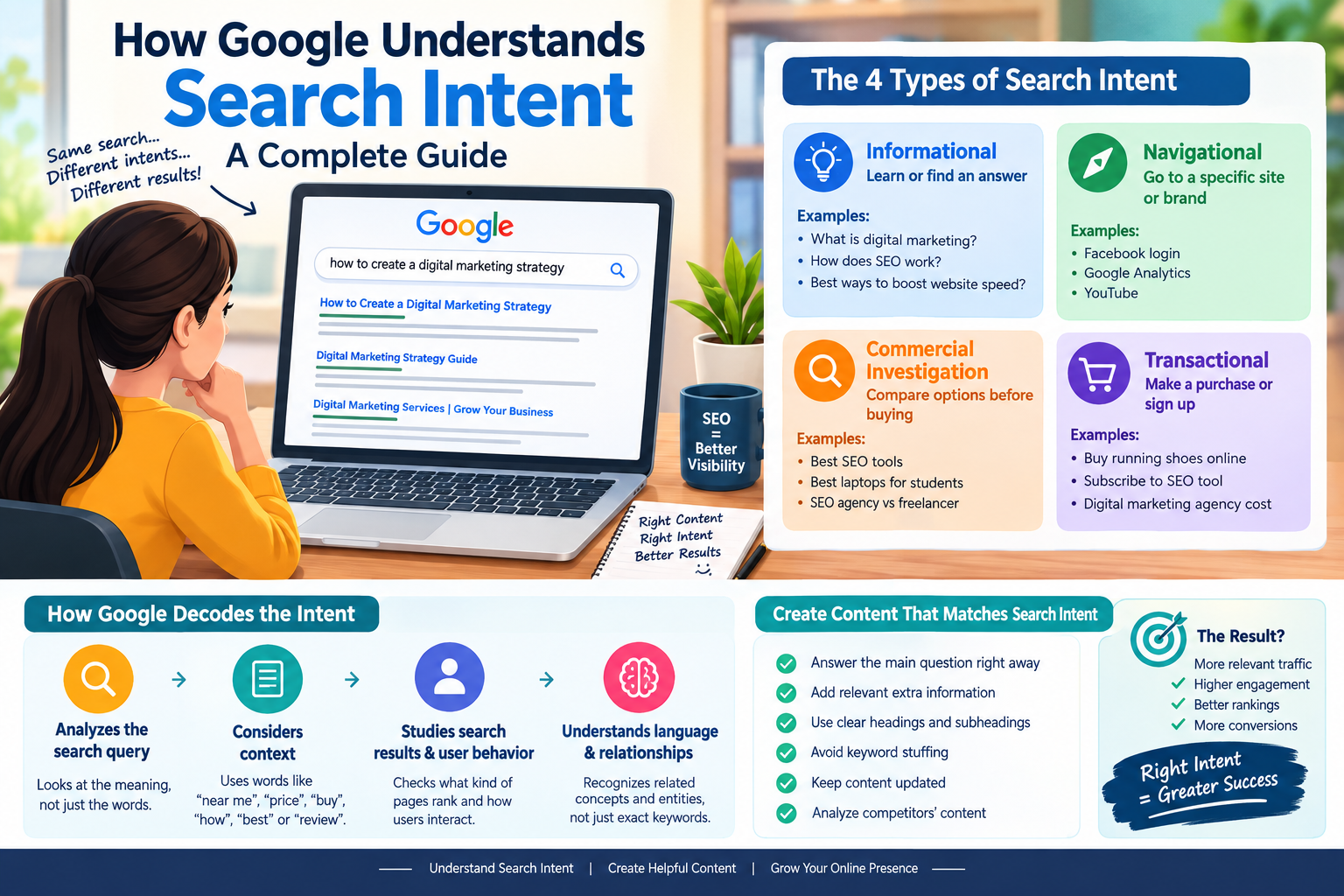
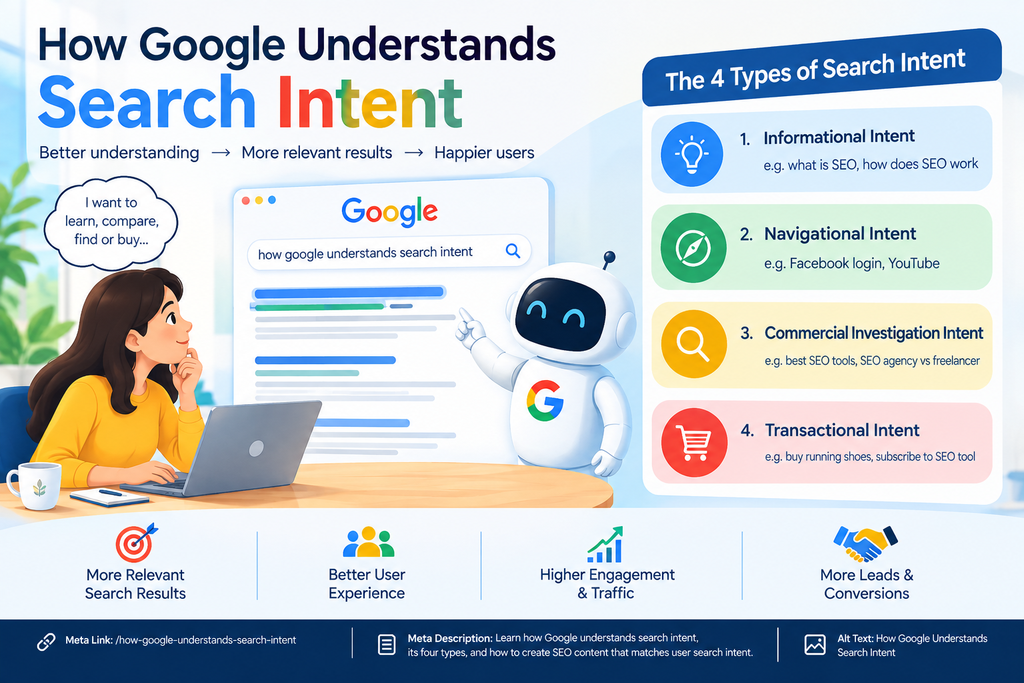
There are four broad categories of search intent.There are four major kinds of search intent.
Knowing the primary search intent categories can make it simpler to write a more relevant piece of SEO content.
1. Informational Intent
Informational Searches occur when the user is attempting to learn something or find an answer.
Examples include:
What is digital marketing?
How does SEO work?
The best ways to boost website speed?
Content marketing offers several benefits.There are benefits to content marketing.
Usually, these searches are looking for educational material like a guide, a tutorial, a definition or explanation.
For informational intent, a blog post, detailed guide, or how-to article is suitable.
2. Navigational Intent
Navigational searches are used when someone is looking for a specific website, page or brand.
Examples include:
Facebook login
Google Analytics
Nike website
YouTube
The user already has an intention of a destination. Google tries to find the most relevant and authoritative official or authoritative result for the query.
Navigational searches can help businesses maintain up to date brand information and make sure that key pages are easily found.
3. Commercial Investigation Intent
Commercial investigation searches occur when users are looking for options prior to making a purchase decision.
Examples include:
Best SEO tools
Best laptops for students
Established SEO agency versus freelancer.SEO agency vs freelancer.
HubSpot alternatives
Best email marketing platforms
They can be users who aren’t ready to purchase at this time, but are getting closer.
This intent can be met through comparison articles, reviews, product guides and detailed evaluations.
4. Transactional Intent
Transactional searches indicate that users are ready to take an action, often making a purchase or signing up for a service.
Examples include:
Shop for running shoes on the internet.
Subscribe to an SEO tool to get regular updates on the latest tactics.
Digital marketing agency cost is a subject that encompasses many things.
Buy the laptop from online sources.
Landing pages, product pages, pricing pages, or service pages may be better suited for transactional intent rather than informational articles.
How Google Decodes the Intent behind a Search Query?
Google employs several signals and systems to interpret the intent of users searching.
Google Analyzes the search query.
The first step is to know the words and phrases in the search.
Google doesn’t just look at the individual word, but at the meaning of the query.
For instance, the search term “SEO” is different from “what is SEO” and “SEO agency near me”, and the meaning they have is significantly different from each other and may involve a different intent.
The surrounding words around the main word give the context.
Google Considers Context
Search queries are not in isolation. Google can infer meaning from the context to better understand what a user is trying to find.
The use of phrases like “near me”, “price”, “buy”, “how”, or “best” or “review” can give you an idea of what they want to do.
This helps Google differentiate between informational, commercial and transactional searches.
Google Studies Search Results and User Behavior
Google assesses the quality of search results to the users. It can leverage different signals that stem from search interactions and search result quality to make improvements to its systems.
For instance, when someone has a specific search intent, some results might be more relevant to that search than others, as they consistently tend to give answers that meet the searcher’s need.
But, SEO experts shouldn’t aim for influencing individual users. The more effective way to do this is to produce content that is so useful and addresses the user’s issue.
Google can read the language and comprehend the meaning behind it.
Modern search systems have a much better understanding of natural language than keyword matching.
Google can understand relationships between words, concepts and entities. This does not mean that a website has to use a particular word or phrase multiple times, or even in a line.That does not mean that a website must have a particular word or phrase repeated many, many times, or even in a line.
On the other hand, a piece on “how to improve Google rankings” will naturally include topics like keyword research, technical optimization, content quality, backlinks, search intent and website performance.
These concepts are related and assist the search engine to grasp the general topic.
The strategies for determining search intent before crafting content.The methods to discovering search intent before producing content.
It is important to find out what users will want to read before writing an article.
Analyze the Search query.
Pay attention to the exact words of the target keyword.
Words such as:
- What is typically the sign for informational purpose.
- How often show informational and/or instructional purpose.
- Commercial investigation is usually suggested by best.
- Price may be a sign of commercial or transactional intent.
- Purchase implies a purchase intent.
- Near me often is for local intent.
These will help but depending on search results, one should also keep in mind.
Compare the search results from the current search.Compare the current search results.
The simplest method to comprehend search intent is to conduct a search for your target keyword on Google and analyze the results.
Check out the kinds of pages ranking:
- Blog posts
- Product pages
- Service pages
- Videos
- Category pages
- Comparison articles
- Local business listings
If the majority of the top-ranking pages are detailed guides, then it is probably ‘informational’ because that is what Google is most likely looking for.
If product and service pages are present, it is likely commercial or transactional.
How to Create Content That Matches Search Intent
After you know what you want them to accomplish, organize your material around what they actually intend to do.
Provide an answer to the Main Question Promptly.
Avoid forcing the user to read a few paragraphs before getting the answer. Begin the response to the main question in a clear way
.
Include Relevant Additional Information
Once you’ve answered the main question, give examples, explanations, steps, statistics, comparisons, or practical advice that will help the user go deeper.
Use Clear Headings and Subheadings
Use H2 and H3 headings to structure your content. This helps users scan the page and assists search engines in structuring the page.
Avoid Keyword Stuffing
Don’t overuse your target word. Add keywords and terms that are relevant and fit the context if appropriate, but avoid overstuffing with keywords.
Update Content Regularly
Search query and goal can evolve over time. The evolution of technology, products, trends and user expectations can impact a searcher’s needs.
Check key information on a regular basis and make sure it is current and relevant.
Common Search Intent Errors to Steer Clear Of
Many websites fail because they are not providing the content that the user is looking for.
Common errors are:
- Keyword targeting without understanding the intent behind them
- Producing promotional material for informational queries.
- Creating articles which don’t answer specific questions
- Refusing to provide information requested by the commercial investigation
- Repetitive content on all keywords
- Only targeting keyword density
- Not analyzing competing search results
- Preventing these pitfalls can help in creating a more user-focused and targeted SEO campaign.
Conclusion
Google interprets search intent by analysing the meaning and context of search terms and identifying the best results to meet user needs. The intent of the search can typically be informational, navigational, commercial investigation, or transactional.
Selecting a keyword is just the first step towards successful SEO. Another thing you should educate yourself on is what users are looking for with that keyword and what it is they expect to see.
Producing content that directly addresses users’ queries; offers useful information and is presented in a format they anticipate creates a better overall experience for users and search engines.
In the end, the most effective SEO means more than just visitors to your site. It’s all about knowing what users are looking for and providing the most useful content to satisfy their need.