
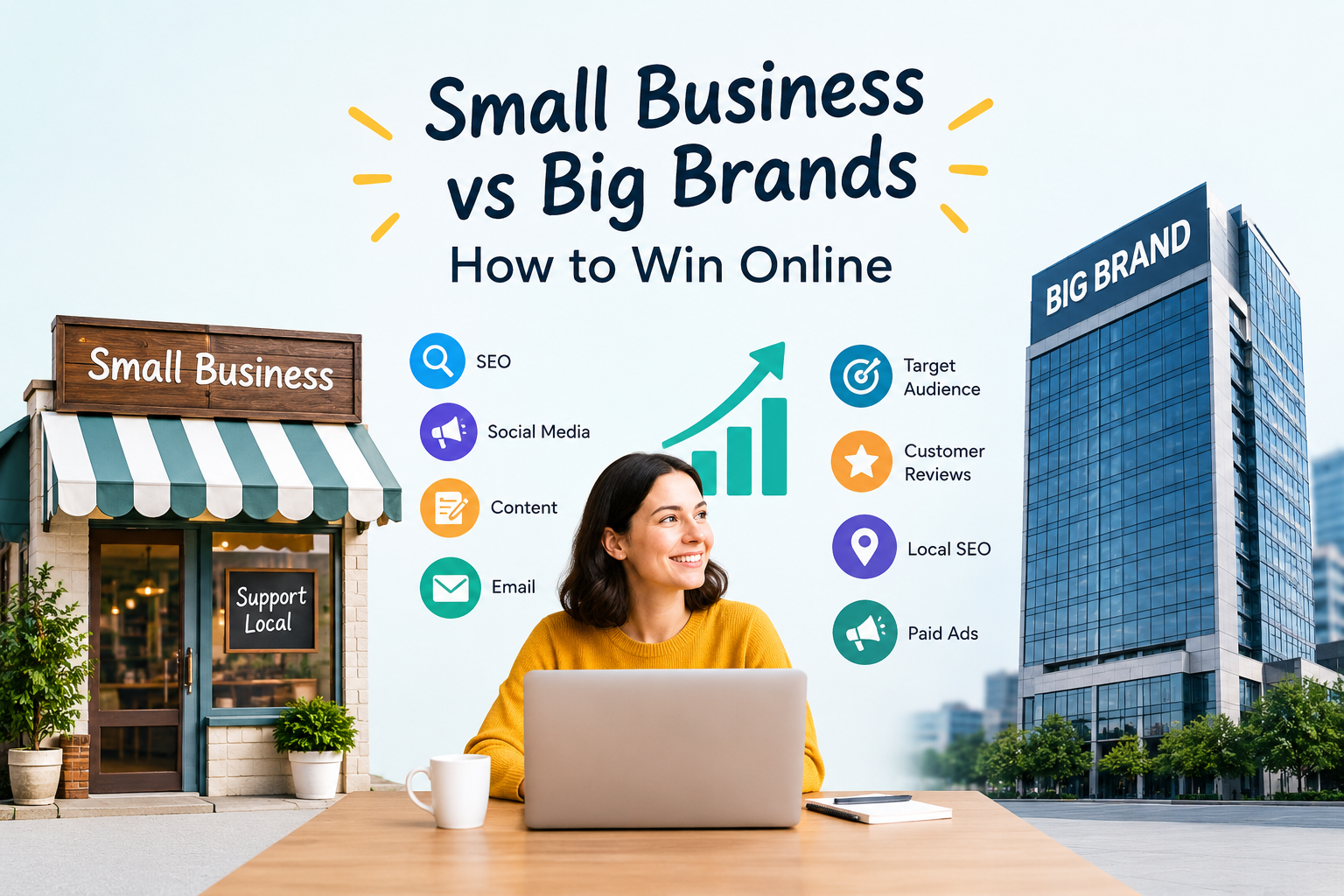
How Small Businesses Can Compete With Big Brands Online Big brands have large marketing budgets, thousands of employees, strong brand recognition, and years of experience. At first glance, it may seem almost impossible for a small business to compete with them online.
But the internet has changed the rules.
A small business does not need the biggest budget to attract customers. With the right digital marketing strategy, a clear target audience, useful content, strong customer relationships, and smart use of SEO and social media, smaller businesses can build visibility and compete for attention in crowded markets.
The goal is not necessarily to become bigger than a major brand. Instead, small businesses should focus on becoming more relevant, more accessible, and more valuable to their specific customers.
From local SEO to content marketing, online reviews, social media, email marketing, and paid advertising, there are many ways smaller companies can create an online presence that attracts and converts customers
Let’s explore how.
Why Small Businesses Can Compete Online
Traditional advertising often favors businesses with large budgets. Television commercials, billboards, newspapers, and large-scale campaigns can be expensive.
Digital marketing provides more flexible options.
A small business can create a website, publish helpful content, optimize its Google Business Profile, communicate with customers on social media, collect reviews, and run targeted advertising without spending the same amount as a multinational company.
More importantly, customers do not always choose a company simply because it is famous.
They may choose a business because it:
- Understands their specific needs
- Offers personalized service
- Has excellent reviews
- Provides useful information
- Responds quickly
- Is located nearby
- Offers competitive pricing
- Feels trustworthy and authentic
These are areas where small businesses can create meaningful advantages.
1. Find a Specific Niche
One of the biggest mistakes small businesses make is trying to appeal to everyone.
Large brands can sometimes afford broad marketing campaigns. Small businesses usually benefit from being more specific.
Instead of targeting “people who need digital marketing,” for example, a small agency could target:
“Digital marketing for local restaurants and cafés.”
This creates a much clearer audience.
Identify Your Ideal Customer
Ask questions such as:
- Who is most likely to buy from us?
- What problems are they trying to solve?
- What questions do they search for online?
- Where do they spend time online?
- What factors influence their buying decision?
- What makes them choose one competitor over another?
Once you understand your ideal customer, your website content, advertisements, social media posts, and offers can become much more relevant.
Become Known for Something Specific
Instead of trying to compete with a large brand across every category, own a smaller space.
A focused niche can make it easier to build authority and attract customers who are specifically looking for what you provide.
2. Build a Strong Website
Your website is often the center of your online presence.
A small business website does not need hundreds of pages or complicated animations. It needs to be clear, fast, useful, mobile-friendly, and trustworthy.
Essential Website Elements
Your website should clearly communicate:
- What your business does
- Who you help
- What products or services you offer
- Why customers should choose you
- How customers can contact you
- Where you operate
- What previous customers say about you
Use clear calls to action such as “Get a Quote,” “Book a Consultation,” “Call Now,” or “Shop Now.”
A visitor should understand what to do next without searching through multiple pages.
3. Use SEO to Compete for Search Visibility
Search engine optimization is one of the most valuable long-term strategies for small businesses.
SEO helps your website appear when potential customers search for relevant products, services, questions, or solutions.
For example, a local bakery may target searches such as:
- Best bakery near me
- Birthday cake delivery
- Custom cakes in [city]
- Wedding cakes near me
- Eggless cake delivery
Instead of competing for extremely broad keywords, small businesses can focus on specific, relevant search terms.
Focus on Long-Tail Keywords
Long-tail keywords are usually more specific search phrases.
For example:
Broad: “shoes”
Specific: “comfortable running shoes for beginners”
The more specific search can attract people with a clearer intention.
Small businesses can create blog posts and service pages around questions and phrases their customers actually search for.
Create Helpful Content
Do not create content simply to insert keywords.
Create content that answers real customer questions.
Examples include:
- How-to guides
- Buying guides
- Frequently asked questions
- Product comparisons
- Industry tips
- Case studies
- Tutorials
- Problem-solving articles
Useful content can attract search traffic and demonstrate expertise at the same time.
4. Make Local SEO a Priority
For businesses serving a particular area, local SEO can be extremely important.
A local customer may not care whether a company has thousands of employees. They want a business that can solve their problem nearby.
Optimize your online presence for location-based searches.
Optimize Your Google Business Profile
Keep your business information accurate and complete.
Include:
- Correct business name
- Address
- Phone number
- Website
- Business hours
- Services
- Photos
- Relevant business categories
Encourage genuine customers to leave reviews and respond professionally to reviews.
Consistent and accurate business information can also help customers find and contact you more easily.
5. Use Social Media to Build Relationships
Social media gives small businesses an opportunity that traditional advertising often lacks: direct communication with customers.
Instead of only promoting products, use social media to show the people and ideas behind your business.
Share Different Types of Content
You can publish:
- Educational tips
- Product demonstrations
- Behind-the-scenes content
- Customer stories
- FAQs
- Short videos
- Industry insights
- New product announcements
- Company updates
The goal is to create content that people find useful or interesting.
Be Human and Authentic
A large company may have multiple departments managing its social media.
A small business can use its size as an advantage.
Show the owner, team, production process, workspace, or customer experience when appropriate.
People often appreciate knowing who is behind a business.
6. Use Customer Reviews as Social Proof
Online reviews can influence purchasing decisions because potential customers want evidence that a business delivers what it promises.
A small company with strong genuine reviews can build credibility even when competing against a much larger brand.
How to Encourage Reviews
After a successful purchase or service, politely ask customers to share their honest experience.
Make the process simple.
You can also respond to reviews—both positive and negative—in a professional manner.
Do not manufacture or manipulate reviews. Authentic customer experiences are much more valuable for long-term trust.
7. Create a Strong Brand Identity
Branding is not only about a logo.
Your brand includes your:
- Voice
- Visual identity
- Values
- Customer experience
- Messaging
- Reputation
- Positioning
A small business can create a memorable identity by being consistent.
Use similar colors, fonts, messaging, photography, and tone across your website and social media channels.
Tell Your Story
Large brands often have polished corporate messaging.
Small businesses can tell a more personal story.
Explain why the business was created, what problem it solves, what it believes in, and how it serves customers.
A genuine story can help customers understand what makes your business different.
8. Use Content Marketing to Build Authority
Content marketing can help small businesses demonstrate expertise before asking customers to buy.
Imagine a customer searching for information about a problem.
If your blog, video, or social media content provides a useful answer, that customer may begin to recognize your business as a knowledgeable source.
Over time, consistent content can support:
- Brand awareness
- Organic traffic
- Customer trust
- Lead generation
- Search visibility
- Sales
Focus on Customer Problems
Instead of constantly writing about your company, create content around customer needs.
For example, a home renovation company could publish:
“10 Questions to Ask Before Hiring a Home Renovation Contractor.”
That content helps potential customers while introducing them to the company’s expertise.
9. Use Email Marketing
Social media algorithms can change, but your email list is an audience you can communicate with directly.
Small businesses can use email marketing to build long-term relationships.
Send useful and relevant messages such as:
- New product announcements
- Helpful guides
- Special offers
- Company updates
- Educational content
- Event invitations
- Personalized recommendations
Avoid sending excessive promotional emails.
The goal should be to provide value while keeping your business memorable.
10. Use Paid Advertising Strategically
Small businesses do not always need huge advertising budgets.
The key is targeting.
Platforms such as Google Ads and social advertising platforms allow businesses to target specific audiences, locations, interests, and search intent.
Start Small and Measure Results
Instead of spending a large amount immediately, begin with a controlled campaign.
Track metrics such as:
- Click-through rate
- Cost per click
- Leads
- Conversion rate
- Cost per lead
- Sales
- Return on advertising spend
Use the results to improve the campaign.
If one advertisement generates better results, analyze why and use that information to improve future campaigns.
11. Compete Through Customer Experience
A customer does not experience your marketing campaign only when they click an advertisement.
They experience your business through every interaction.
That includes:
- Website experience
- Communication
- Purchasing process
- Delivery
- Customer support
- Follow-up
- Problem resolution
A small business can differentiate itself by providing responsive and personalized service.
Make Customers Feel Valued
Simple actions can make a difference.
Respond quickly to questions. Explain your services clearly. Follow up after a purchase when appropriate. Solve problems professionally.
Customer experience can become an important part of your competitive advantage.
12. Use Data Instead of Guesswork
Digital marketing gives businesses access to useful performance information.
Instead of asking, “Did our marketing work?” you can examine specific metrics.
For example:
- How many people visited the website?
- Where did visitors come from?
- Which pages received the most traffic?
- Which keywords generated visitors?
- How many visitors became leads?
- Which campaigns generated sales?
Test and Improve
Digital marketing should be treated as an ongoing process.
Test different:
- Headlines
- Images
- Offers
- Landing pages
- Calls to action
- Content formats
- Advertising messages
Then use performance data to determine what needs improvement.
13. Collaborate With Other Small Businesses
Competition is not the only way to grow.
Small businesses can collaborate with complementary businesses to reach new audiences.
For example, a wedding photographer could collaborate with:
- Wedding planners
- Florists
- Makeup artists
- Event venues
- Cake designers
Businesses can cross-promote relevant services, create joint content, or organize events.
These partnerships can introduce each company to potential customers who already have related needs.
14. Focus on Retaining Existing Customers
Acquiring a new customer can require significant marketing effort.
That makes customer retention important.
Build relationships after the first purchase.
You can use:
- Loyalty programs
- Follow-up emails
- Helpful content
- Personalized recommendations
- Customer support
- Exclusive updates
Satisfied customers may also recommend your business to friends, family, or colleagues.
15. Use AI as a Productivity Tool
Artificial intelligence is increasingly becoming part of digital marketing.
Small businesses can use AI tools to assist with tasks such as:
- Brainstorming content ideas
- Creating initial content outlines
- Analyzing customer questions
- Generating advertising variations
- Summarizing data
- Organizing marketing workflows
However, AI-generated material should be reviewed and improved by people.
Your business experience, customer knowledge, original insights, and brand voice are what make content genuinely useful.
Common Mistakes Small Businesses Should Avoid
Trying to compete online does not mean being active on every platform.
Avoid these common mistakes:
Trying to Be Everywhere
Choose platforms where your customers actually spend time.
Copying Big Brands
Study competitors, but build your own identity.
Focusing Only on Followers
A large follower count does not automatically mean more sales.
Focus on meaningful metrics such as leads, conversions, revenue, engagement quality, and customer retention.
Ignoring Mobile Users
Many customers browse and purchase through mobile devices. Make sure your website works well on smaller screens.
Expecting Instant Results
SEO and content marketing can take time. Paid advertising can produce faster feedback, but campaigns still require testing and optimization.
A Practical Digital Marketing Strategy for Small Businesses
A simple strategy can begin with five steps.
Step 1: Define Your Audience
Identify your ideal customers and their biggest problems.
Step 2: Build Your Foundation
Create a professional website and establish accurate business information across relevant online platforms.
Step 3: Choose Your Main Channels
Focus on the channels most relevant to your audience, such as SEO, social media, email, or paid advertising.
Step 4: Publish Useful Content
Answer customer questions and demonstrate your expertise.
Step 5: Measure and Improve
Track performance regularly and invest more effort into strategies that produce meaningful business results.
Conclusion
Small businesses do not have to match the budgets, workforce, or advertising reach of big brands to compete online. Digital marketing provides opportunities to build visibility through focus, relevance, expertise, customer relationships, and consistent execution.
The biggest advantage for a small business can be its ability to understand a specific audience deeply. By targeting a clear niche, investing in SEO, improving local visibility, creating useful content, building a recognizable brand, collecting genuine reviews, and delivering excellent customer experiences, a small business can establish a strong online presence.
The most effective strategy is not to copy what large companies are doing. It is to identify what your customers need and find better ways to serve them.
Start with the basics: understand your audience, create a useful website, improve your search visibility, choose the right marketing channels, and measure your results.
You do not need to dominate the entire internet.
You need to be visible to the right people, at the right time, with the right message.
That is how small businesses can build sustainable growth and compete with much larger brands online.