Introduction
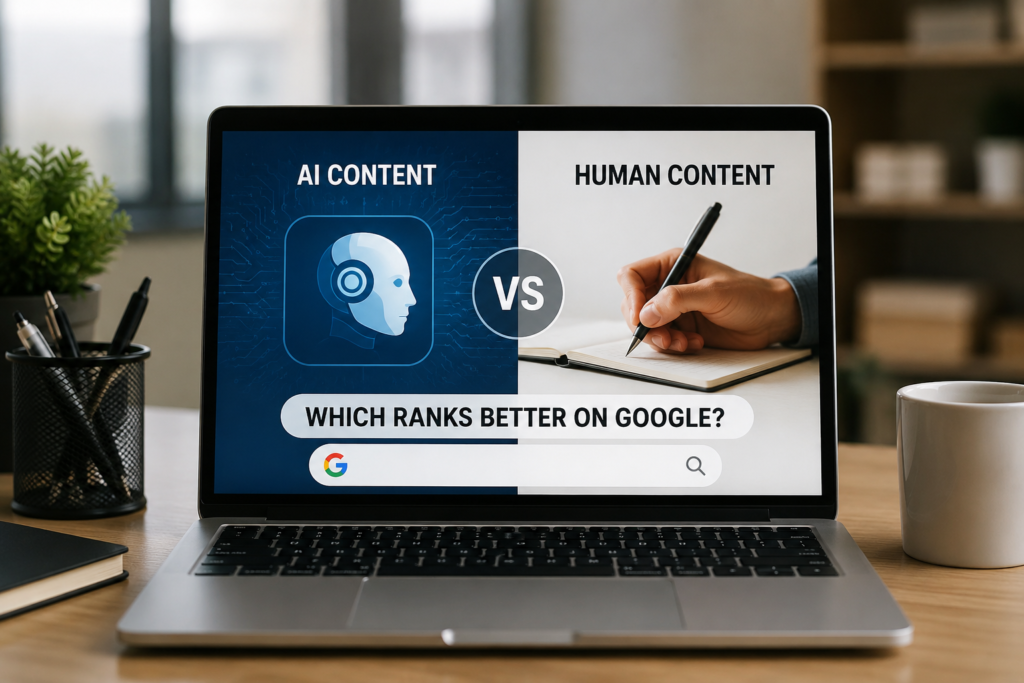
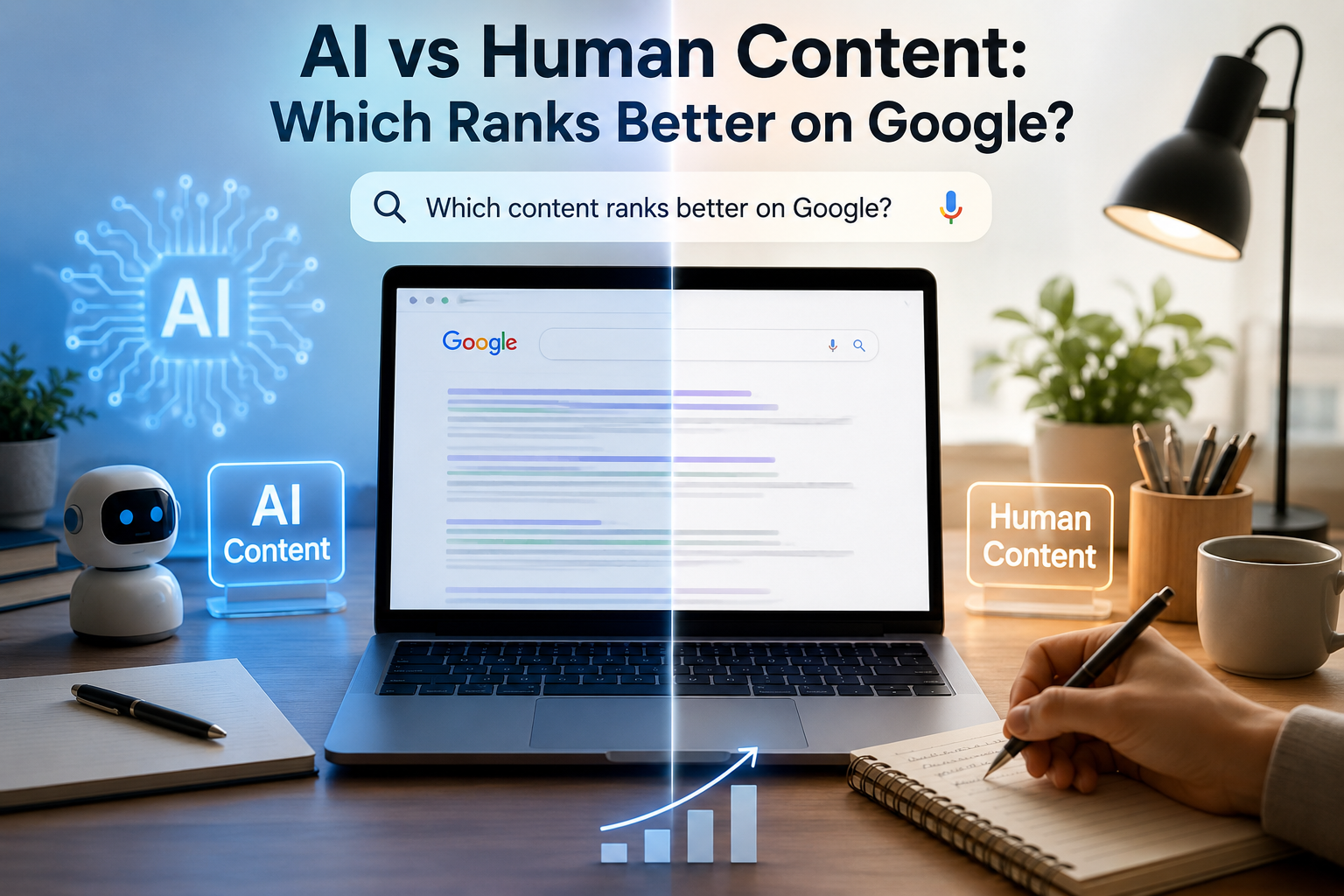
AI vs Human Content has become one of the biggest debates in digital marketing and SEO. With advanced AI writing tools capable of producing articles within minutes, many website owners wonder whether AI-generated content can rank as well as content written by humans. The short answer is yes—but only if the content provides real value to users.
In 2026, Google does not reward or penalize content simply because it was written by AI or a human. Instead, Google’s algorithms prioritize helpful, accurate, trustworthy, and user-focused content. Whether you use AI, human writers, or a combination of both, success depends on quality rather than the method of creation.
This guide explains how Google evaluates content, compares AI-generated and human-written content, highlights the advantages and disadvantages of each, and shares practical SEO strategies to help your content rank higher in search results.
What Is AI ?
AI vs Human Content content is text created with the help of artificial intelligence tools. These tools analyze vast amounts of information and generate articles, blog posts, product descriptions, emails, social media captions, and marketing copy within seconds.
Popular AI writing tools can help with:
- Blog writing
- SEO optimization
- Content outlines
- Meta titles and descriptions
- Email marketing
- Product descriptions
- Social media posts
- Content ideation
AI significantly reduces the time required to produce content, making it a valuable assistant for marketers and businesses.
What Is Human Content?
Human content is written by people using their knowledge, expertise, creativity, and personal experience. AI vs Human Content writers can understand emotions, audience intent, storytelling, and brand voice more naturally than AI.
Human-written content often includes:
- Personal experiences
- Industry expertise
- Original opinions
- Case studies
- Real examples
- Emotional storytelling
- Creative insights
These qualities make human content more engaging and trustworthy for readers.
Does Google Prefer AI vs Human Content?
The simple answer is Google prefers neither AI nor human content—it prefers helpful content.
Google’s ranking systems focus on whether content satisfies user intent and demonstrates experience, expertise, authoritativeness, and trustworthiness (often referred to as E-E-A-T). If AI-generated content is accurate, original, and useful, it can rank well. Likewise, poorly written human content can perform poorly.
Google evaluates content based on factors such as:
- Relevance to the search query
- Accuracy of information
- Originality
- User experience
- Content depth
- Website authority
- Internal linking
- Page speed
- Mobile friendliness
- Helpful information
The source of the content matters far less than the value it provides.
AI Content: Advantages
1. Faster Content Creation
AI can generate thousands of words in minutes, helping businesses publish content consistently.
2. Cost-Effective
Using AI reduces content production costs, especially for startups and small businesses.
3. SEO Assistance
Many AI tools help optimize headings, keywords, meta descriptions, and readability.
4. Content Ideas
AI can generate topic ideas, FAQs, and outlines based on trending search queries.
5. Multilingual Support
AI can translate and adapt content for different languages, expanding your audience.
AI Content: Limitations
Despite its benefits, AI has several drawbacks.
Limited Original Experience
AI cannot share firsthand experiences or personal case studies.
Generic Information
Many AI-generated articles contain widely available information that lacks uniqueness.
Occasional Inaccuracies
AI can produce outdated or incorrect facts if outputs are not reviewed carefully.
Weak Emotional Connection
AI often struggles to create authentic storytelling that resonates with readers.
Risk of Duplicate-Like Content
Publishing AI content without editing can result in generic articles that fail to stand out.
Human Content: Advantages
Original Insights
Human writers contribute unique perspectives and practical experience that AI cannot replicate.
Better Storytelling
People naturally connect with stories, making human-written content more engaging.
Strong Brand Voice
A skilled writer maintains a consistent tone that reflects the brand’s identity.
Higher Trust
Readers are more likely to trust content supported by real-world expertise and examples.
Better Decision-Making
Humans understand context, nuance, and audience expectations more effectively.
Human Content: Limitations
Human writing also has challenges.
- Requires more time
- Higher production costs
- Limited scalability
- Research can be time-consuming
- Quality varies depending on the writer’s expertise
AI vs Human Content Comparison
| Feature | AI Content | Human Content |
| Speed | Excellent | Moderate |
| Cost | Low | Higher |
| Creativity | Moderate | Excellent |
| Original Experience | Limited | Excellent |
| Emotional Appeal | Limited | Strong |
| SEO Support | Excellent | Excellent |
| Fact Accuracy | Needs verification | Depends on research |
| Brand Voice | Requires editing | Natural |
| Scalability | Excellent | Limited |
| User Trust | Good after review | Generally stronger |
Which Content Performs Better in SEO?
The highest-performing content today is usually a hybrid approach that combines AI efficiency with human expertise.
AI can help with:
- Research
- Outlines
- Draft creation
- Keyword suggestions
- Content structure
- Grammar improvements
Human editors should then:
- Verify facts
- Add unique insights
- Include examples
- Improve readability
- Refine tone
- Optimize user experience
- Ensure originality
This combination often produces content that is both efficient and valuable.
Best Practices for Ranking AI vs Human Content
If you use AI to create content, follow these SEO best practices:
Understand Search Intent
Create content that answers the user’s actual question instead of focusing only on keywords.
Add Original Value
Include personal observations, examples, research, or expert commentary that AI cannot provide on its own.
Fact-Check Everything
Review statistics, claims, and technical information before publishing.
Improve Readability
Use:
- Short paragraphs
- Clear headings
- Bullet points
- Tables
- Simple language
These elements improve user experience and make content easier to scan.
Optimize On-Page SEO
Ensure every article includes:
- Primary keyword in the title
- SEO-friendly URL
- Meta title
- Meta description
- Internal links
- Relevant external references where appropriate
- Optimized images with descriptive alt text
Avoid Keyword Stuffing
Use keywords naturally. Focus on answering questions rather than repeating the same phrase.
Keep Content Updated
Refresh older articles with new information to maintain relevance and accuracy.
Common Mistakes to Avoid
Many websites fail to rank because they rely too heavily on automation without editorial review. Avoid:
- Publishing AI output without editing
- Copying competitor content
- Adding unnecessary keywords
- Using misleading headlines
- Ignoring user intent
- Skipping proofreading
- Publishing thin or repetitive articles
- Neglecting technical SEO
Is AI Replacing Human Writers?
AI is changing how content is created, but it is not replacing skilled writers. Instead, it is becoming a productivity tool that helps writers work faster.
Successful content creators use AI for repetitive tasks while relying on human expertise for strategy, creativity, and quality control.
Businesses that combine AI with experienced editors are more likely to produce content that earns trust, attracts readers, and performs well in search results.
Future of AI Content in SEO
As search engines continue to evolve, they are placing greater emphasis on quality, credibility, and user satisfaction. AI tools will become more capable, but the importance of originality, expertise, and trust will continue to grow.
Websites that consistently publish helpful, accurate, and well-structured content—regardless of whether AI assisted in the process—will remain in a strong position to compete in search rankings.
Conclusion
The debate over AI vs Human Content is not about choosing one over the other. Google’s goal is to reward content that genuinely helps users solve problems and answers their questions clearly. AI offers speed, efficiency, and scalability, while human writers contribute creativity, experience, and authenticity.
For the best SEO results in 2026, use AI as a writing assistant—not a replacement for thoughtful editing. By combining AI-generated drafts with human expertise, fact-checking, and original insights, you can create high-quality content that satisfies readers and has a stronger chance of ranking well on Google.